How MetaopAI works · Technical overview

A memory that compounds.
A model that stays stateless.

The pages below are for the technically curious — the KRL substrate, the cognition orchestrator, the composer that hands the model a policy-governed package, and the economics that come out of building this way. If you want the product experience instead, start here.

01 — The approach
An open experiment
// hypothesis The bottleneck in AI utility for personal reasoning isn't model capability — it's structured, persistent context.

// method Build a typed, multi-dimensional memory layer (the KRL) and let interpretation emerge from compounded signal over time.

// posture Patterns, not verdicts.
Probabilistic, not absolute.
Evolving, not static.

Everyone is scaling models.
We're investigating context.

The dominant conversation in AI is about bigger models, better reasoning, longer context windows. All of that matters. But for the kind of dialogue a person actually needs — substantive, accumulating, personally relevant — there's a different question worth asking.

What if the missing layer isn't the model itself, but the way context is structured around it? What if "memory" alone isn't enough — what's needed is a typed, multi-dimensional state that grows in fidelity, decays appropriately, surfaces contradictions, and compounds raw observation into emergent pattern?

MetaopAI is an experiment in that direction. We're not claiming to have solved anything. We're modeling context the way an attentive observer would — and seeing how far that takes us toward AI dialogue that is both more precise and more honest about what it cannot know.

The compounding bet

Raw signals are cheap.
Structured signals over time are not.

02 — Flow
How it works

From conversation to clarity,
in four moves.

The product side is simple. You narrate. The system extracts. Patterns surface. You see yourself and the people around you more clearly than you did yesterday.

01 · Input

Narrate naturally

Write the way you'd talk to a confidant. No prompts to learn, no structure to follow. Tell the story as it happened.

02 · Extract

Signals surfaced

Five parallel extractors identify who, what, where, when, and how — typed observations land in a structured graph.

03 · Compound

Patterns emerge

Signals reinforce, contradict, decay. Compounded across days and weeks, dynamics become visible that no single conversation could have shown.

04 · Insight

Clarity returned

Patterns named. Sources cited. Alternative readings offered. You stay in the chair — the system shows its work, never renders a verdict.

03 — Architecture
The Knowledge Relational Layer

Context isn't a window.
It's a state that compounds.

Under the hood, MetaopAI is built on a typed, multi-dimensional knowledge graph called the KRL. Every observation lands in a specific cell — by subject (the user, an entity, a space, or a relationship pair) and by layer (signal, event, meta-context, context, or pattern).

Stable layers are queried first. Volatile layers update on every turn. Patterns are not extracted — they're computed across the lower layers, with confidence scores, time-decay, and contradiction detection built in.

Layer 01

Signals

Volatile

Small behavioral observations. Raw, granular, highly volatile. The texture of moment-to-moment interaction.

Layer 02

Events

Anchored

Discrete happenings with timestamps. The argument on Tuesday. The promotion in March. Anchors in time.

Layer 03

Context

Most stable

Profile facts & identity. Who someone is, what role they play, the stable scaffolding of a relationship.

Layer 04

Meta-Context

Slow-moving

Subjective atmosphere — how a space feels. Emotional environment and interpretive backdrop.

Layer 05

Patterns

Emergent

Longitudinal interpretations. Computed, not extracted. Reinforced, decayed, reactivated as the lower layers evolve.

From substrate to answer

Five views of the same system at work.

The substrate above is the memory. Here's how MetaopAI turns it into a response — first the loop, then the runtime brain, the package it hands the model, the map back to the product, and what it all costs.

01 · The approach

The brain doesn't live in the window. It lives in the substrate.

General-purpose AI treats the conversation as memory and pays for it on every turn. MetaopAI inverts this: narration becomes structured cognition, retrieval pulls only what's relevant to this scope, and the model becomes a stateless commodity you can swap without losing continuity.
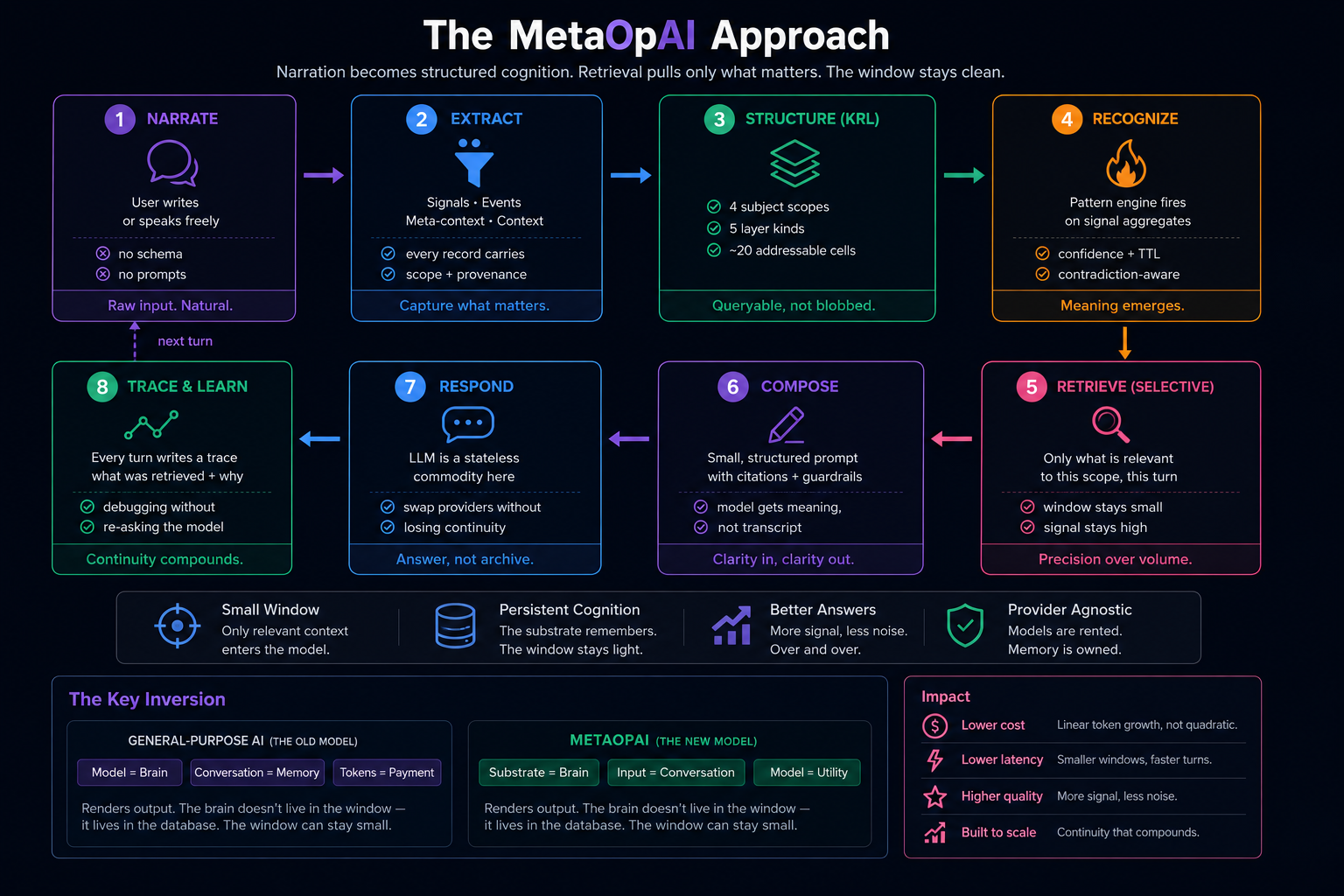
The MetaopAI approach: an eight-step loop — narrate, extract, structure into the KRL, recognize patterns, retrieve selectively, compose, respond, then trace and learn. Contrasts the old model (model = brain, conversation = memory, tokens = payment) with the new model (substrate = brain, input = conversation, model = utility).
Fig. 01 — The key inversion. Narrate → extract → structure → recognize → retrieve → compose → respond → learn.
02 · The orchestrator

A runtime brain that assembles cognition — not a responder.

Every turn, the orchestrator resolves the active policy, retrieves scope-correct continuity from the substrate, classifies intent to decide how deep to think, and builds the directives the composer hands to the model. Its most important decisions are often the moments it chooses to do less.
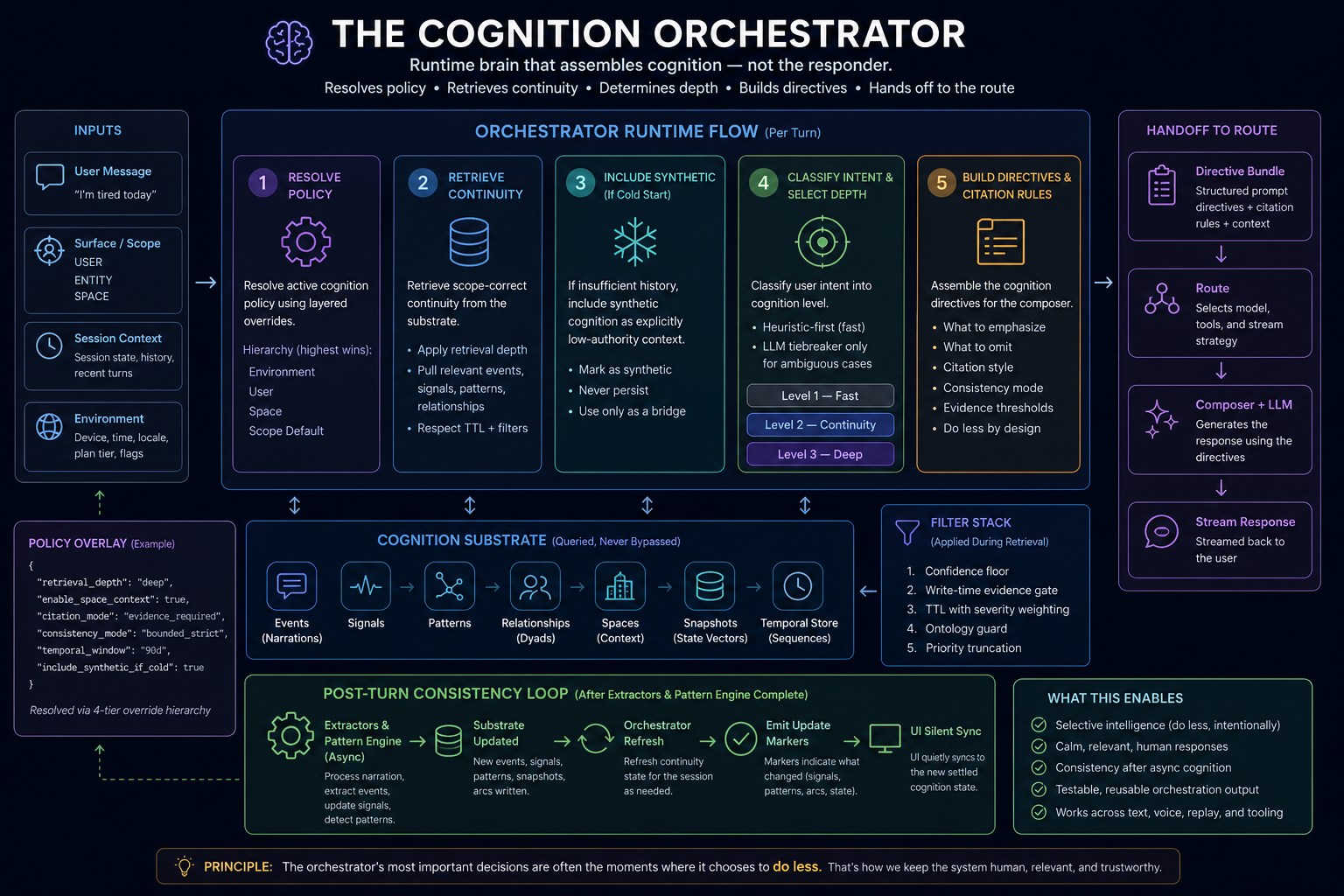
The Cognition Orchestrator runtime flow: resolve policy, retrieve continuity, include synthetic context if cold-start, classify intent and select depth, build directives and citation rules, then hand off to the route — composer, model, and stream. Includes the cognition substrate, filter stack, and post-turn consistency loop.
Fig. 02 — The Cognition Orchestrator. Resolve policy → retrieve continuity → select depth → build directives → hand off.
03 · The composer

One structured package in. One grounded answer out.

The composer takes the orchestrator's directives and assembles a single, policy-governed prompt package — scope-correct continuity, session state, fresh external knowledge, safeguards, and the user's prompt. The model unpacks that package, follows the instructions, and answers strictly within those boundaries.
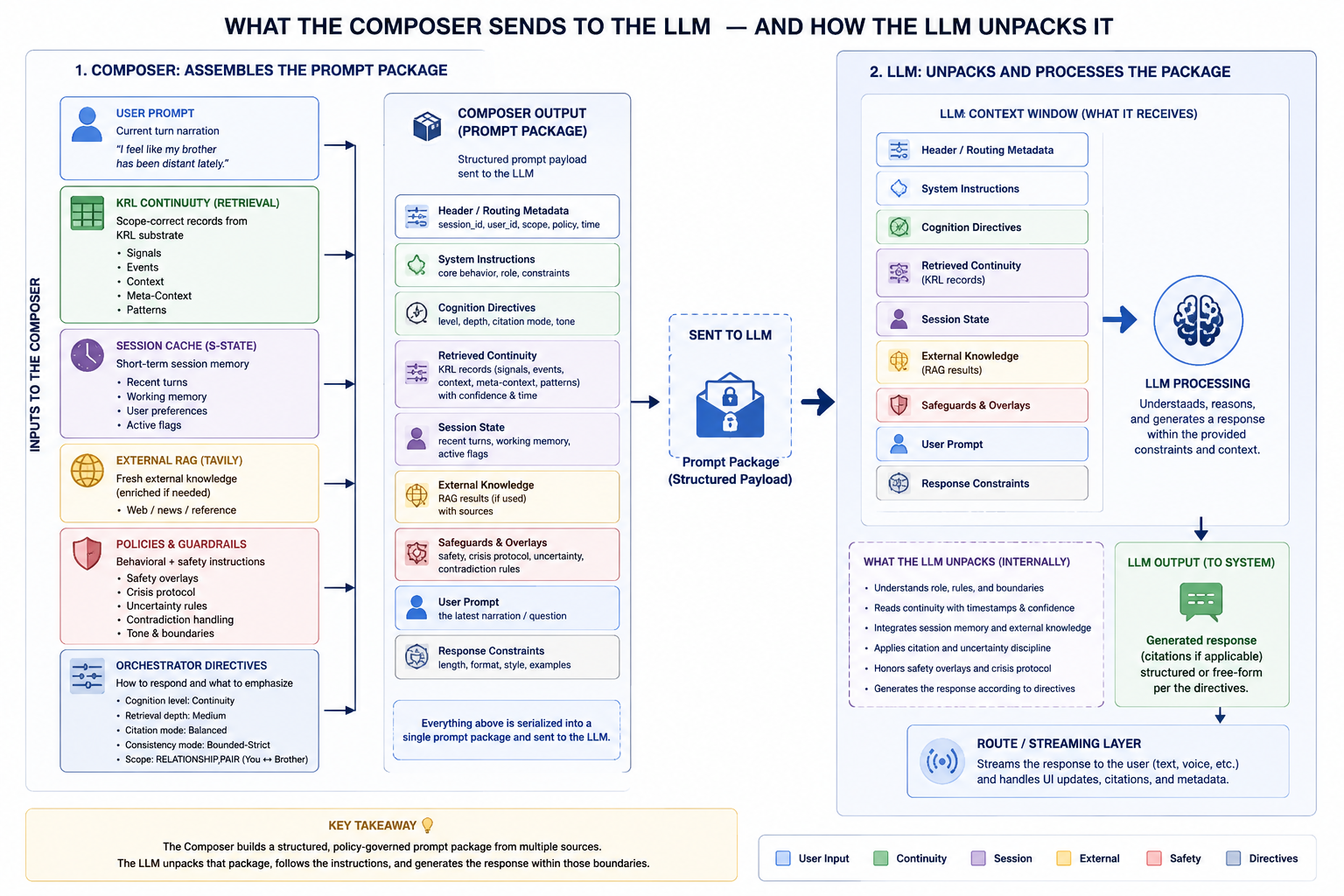
What the composer sends to the LLM and how the LLM unpacks it. The composer assembles a structured prompt package from the user prompt, KRL continuity, session cache, external RAG, policies and guardrails, and orchestrator directives. The LLM receives header and routing metadata, system instructions, cognition directives, retrieved continuity, session state, external knowledge, safeguards, the user prompt, and response constraints — then generates a response within those constraints, streamed back through the route layer.
Fig. 03 — The Composer. Assemble a policy-governed prompt package → the model unpacks it and answers within bounds.
04 · Ontology → product

Four scopes in the substrate. Four homes in the product.

The ontology is the product's spine. User, Entity, Space, and Relationship-pair each map cleanly to where you write and where intelligence is surfaced — every scope is a journal, every journal feeds the same substrate, and every analytic reads from the same scope-correct slice.
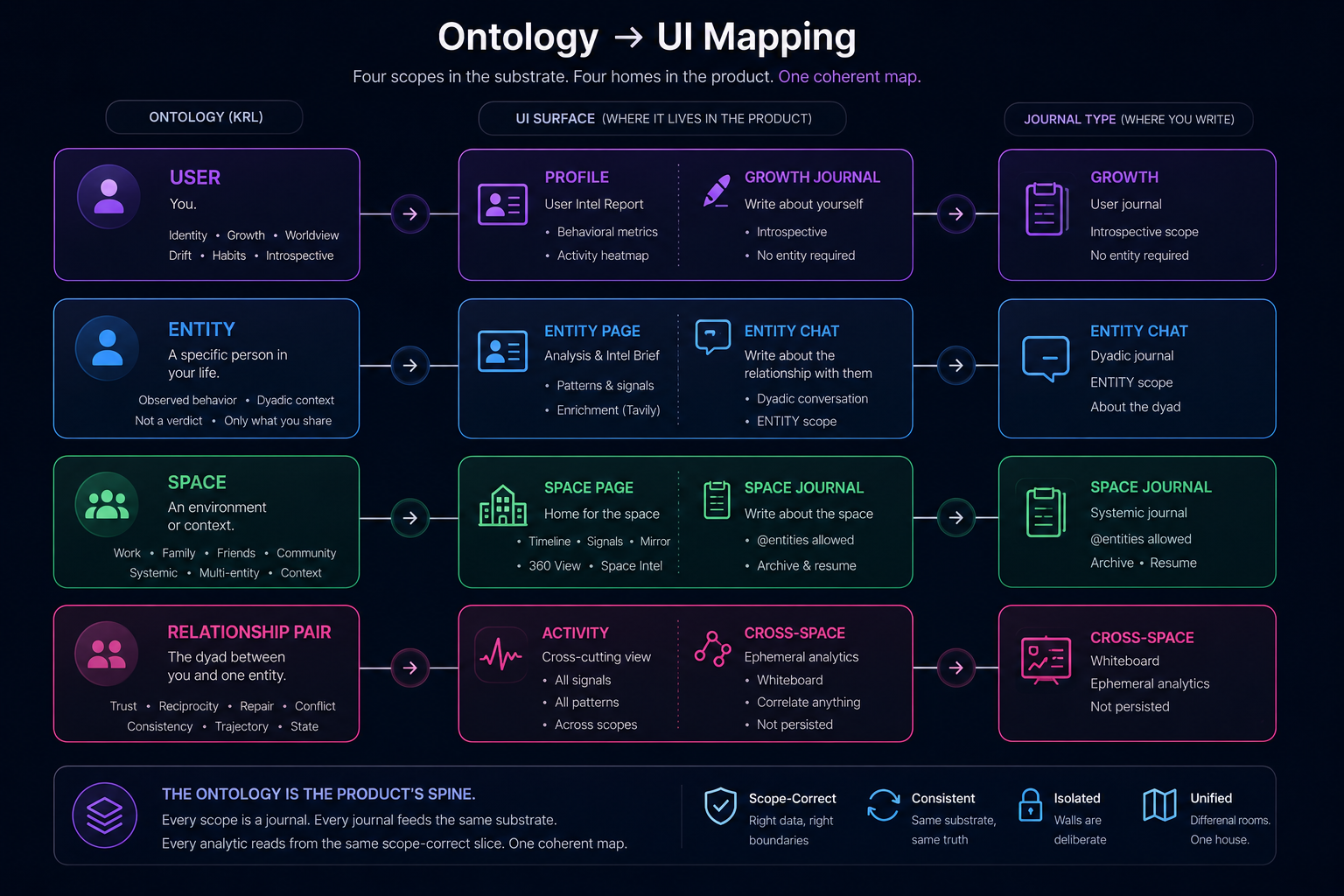
Ontology to UI mapping: the four KRL scopes — User, Entity, Space, and Relationship Pair — each mapped to a UI surface (Profile, Entity page, Space page, Activity and Cross-Space) and a journal type. One coherent map across the product.
Fig. 04 — One coherent map. Scope-correct, consistent, isolated, unified.
05 · The economics

Linear scales. Quadratic breaks.

Replaying the whole conversation every turn means cost grows quadratically — it feels exponential as a thread gets long. Keeping context small and scope-correct holds per-turn cost roughly constant, so cost grows linearly with use. The gap widens the longer someone stays.
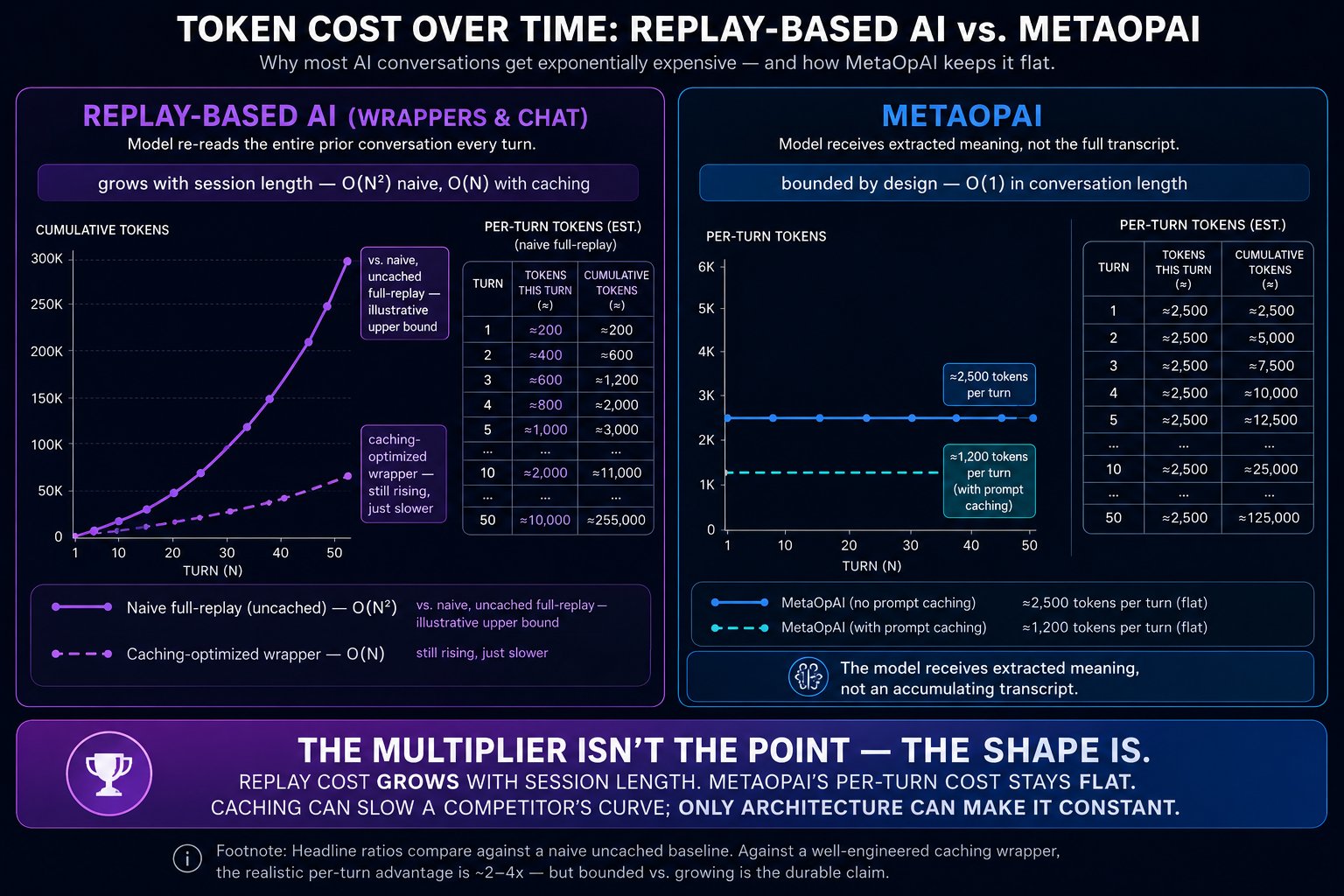
MetaOpAI economics: efficient context-scoped architecture keeps per-turn cost linear while traditional chat-replay models scale quadratically. Cost advantage widens with usage depth.
Fig. 05 — Cost over time. Constant per-turn cost. Lower latency. Higher signal.
04 — Read deeper
The whitepapers

Four views. One product.

The complete reference, plus three focused cuts — a product walkthrough, an investor view, and a technical deep-dive. Pick the read that fits.