Own your artifacts. Choose your reasoning. Keep the ability to walk away.
Your data should remain yours.
MetaopAI was designed around a simple principle: you should own the artifacts you bring into the system.
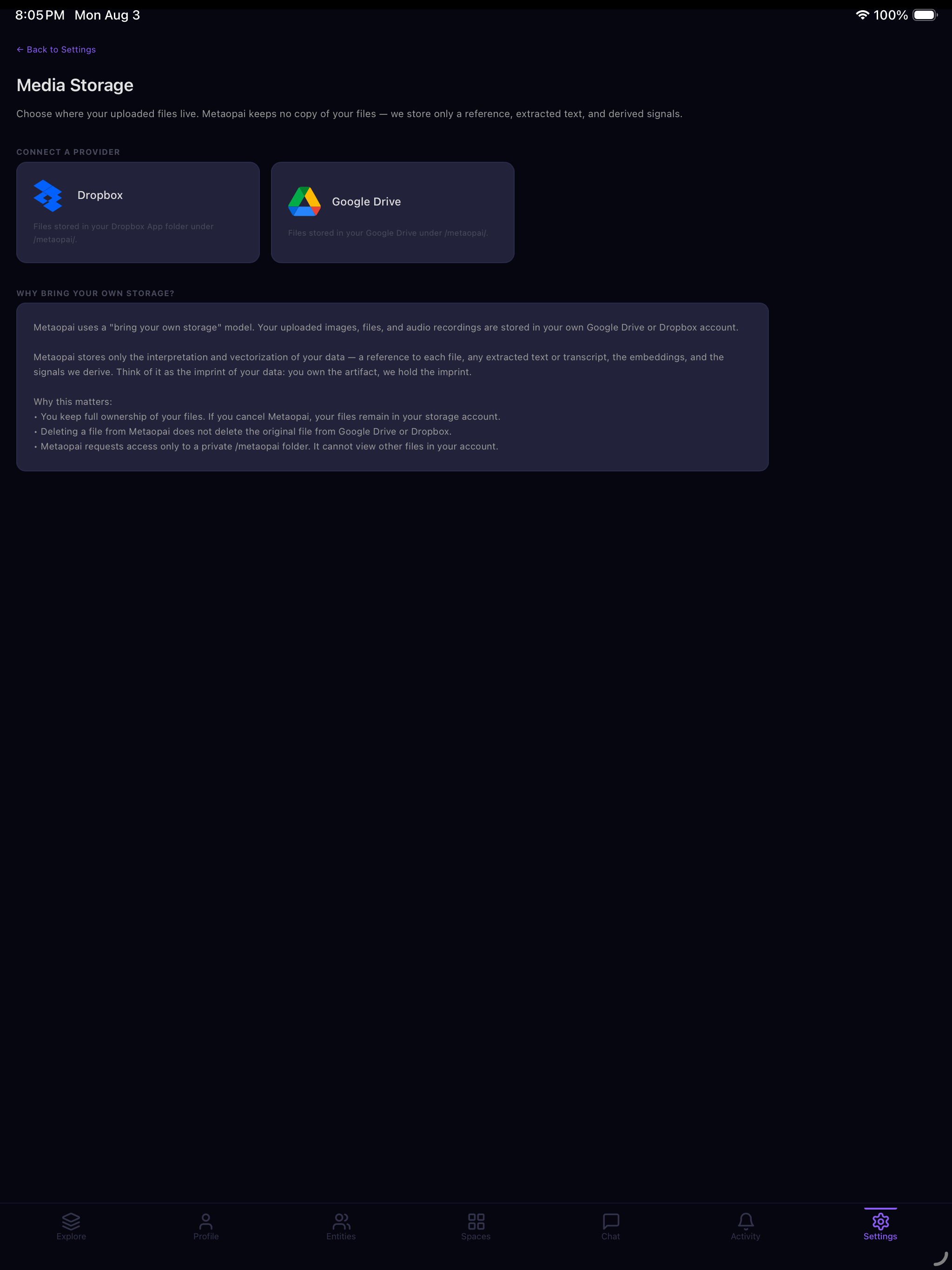
Instead of forcing every file, image, recording, or document into storage controlled by MetaopAI, you can connect your own cloud storage. When connected, MetaopAI creates a dedicated folder inside your storage provider — its access limited to that folder and the content beneath it.
When you upload an image, document, voice recording, Note attachment, or other artifact through MetaopAI, that artifact can live in storage you control. MetaopAI can retrieve and work with those artifacts when needed, but the underlying files remain in your possession.
Think of Bring Your Own Storage as an artifact escrow that you control: MetaopAI can place and retrieve material needed to operate the product, while ownership of the original files remains with you. If you leave MetaopAI, your artifacts do not need to leave with us.
Own the artifact layer.
Files are expensive to retain, secure, back up, govern, and protect. More importantly, we do not believe an AI company needs to own every artifact you give it simply to provide an intelligent service.
With Bring Your Own Storage, you connect a supported cloud provider and authorize MetaopAI to work within a dedicated folder. Artifacts — documents, PDFs, spreadsheets, presentations, images, voice recordings, transcripts, Note attachments, and other uploaded material — can remain in storage you control.
MetaopAI may interpret those artifacts using AI, but the artifact and its interpretation are not the same thing. You own the original file. MetaopAI maintains the contextual interpretation required for the product to understand how that artifact relates to your Spaces, history, people, and prior context.
Those interpretations are cumulative — they may reflect more than the contents of a single file because MetaopAI reasons against the broader context you've built over time. If you delete your MetaopAI account, the account-level context can be deleted while your original artifacts remain in your own storage.
Own the reasoning provider too.
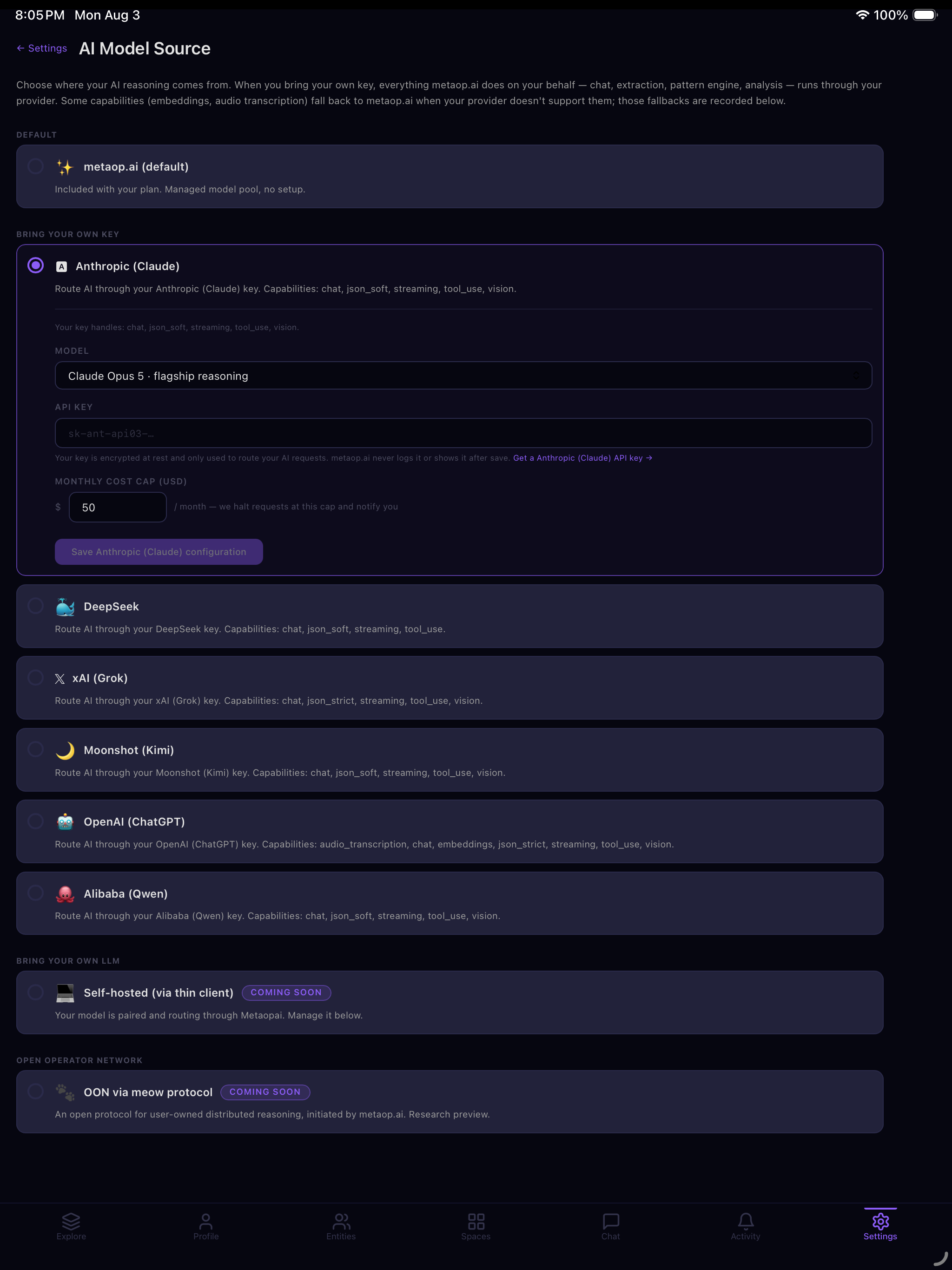
Owning your files solves only part of the problem. You may also care about who performs the reasoning over those files and your journal history.
MetaopAI supports Bring Your Own AI, allowing you to connect a supported AI provider using your own API credentials. That gives you greater control over the chat reasoning layer — including the provider you choose, the account relationship you maintain with that provider, and how that provider handles your chat requests under its own terms. Signal extraction and pattern detection continue to run on MetaopAI's trusted LLM to protect the integrity of your knowledge graph; third-party providers never process your data for extraction.
MetaopAI becomes the continuity layer between your Spaces, Journal, Notes, Entities, and analytics — while the reasoning itself can be supplied through infrastructure you choose.
Your model. Your hardware. Same memory.
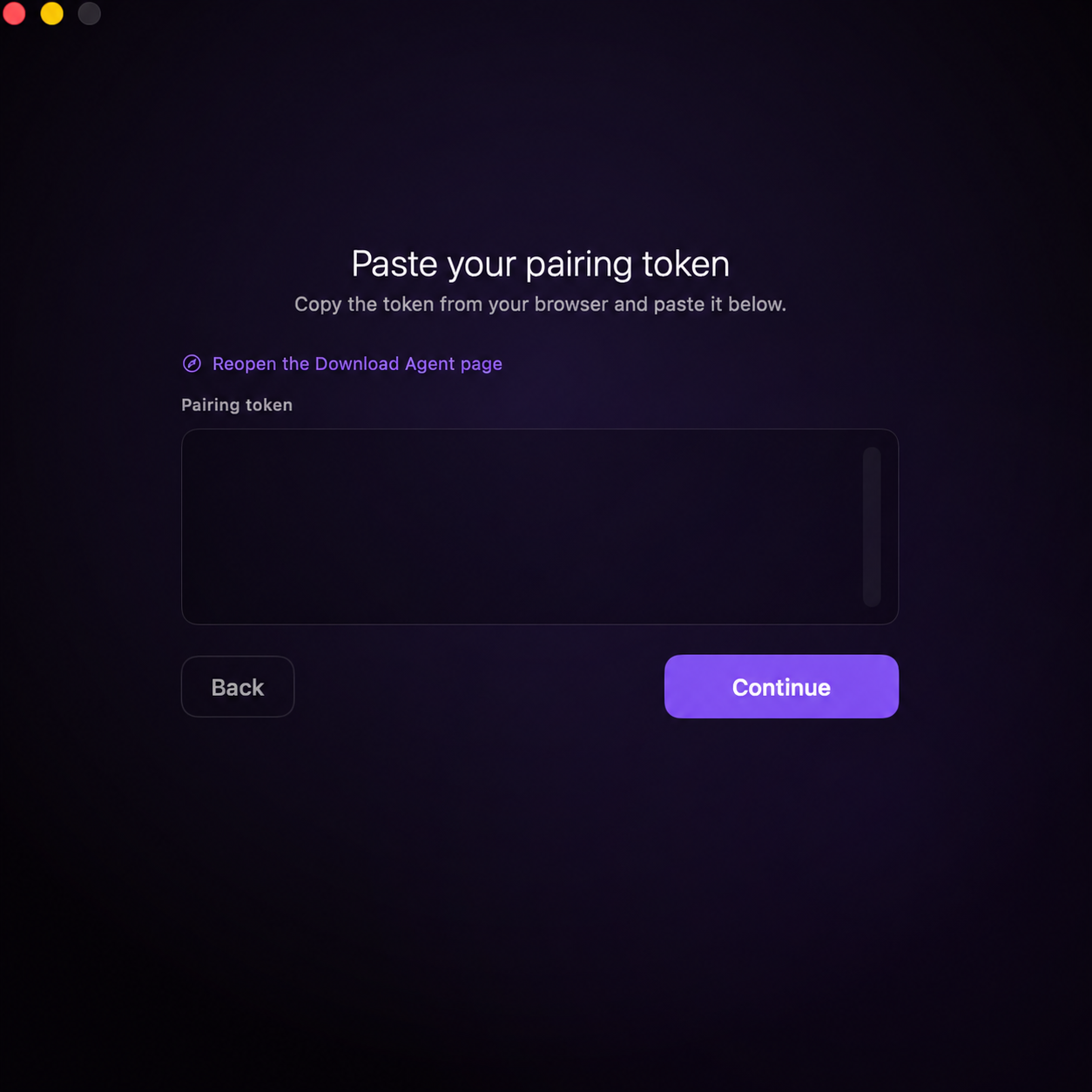
MetaOpai ships a thin client that installs directly on your device. Once installed, it opens a single outbound, persistent, encrypted connection to the MetaOpai backend — an agent that stays connected on your behalf. Prompts issued from the MetaOpai web app or mobile app are routed through that connection down to a model running on your own hardware, and the reasoning happens locally. Third-party providers never see the prompt.
The macOS thin client is distributed as a signed and notarized .dmg — meeting Apple's Developer ID signing and notarization requirements — so Gatekeeper recognizes it as a trusted install on your machine.
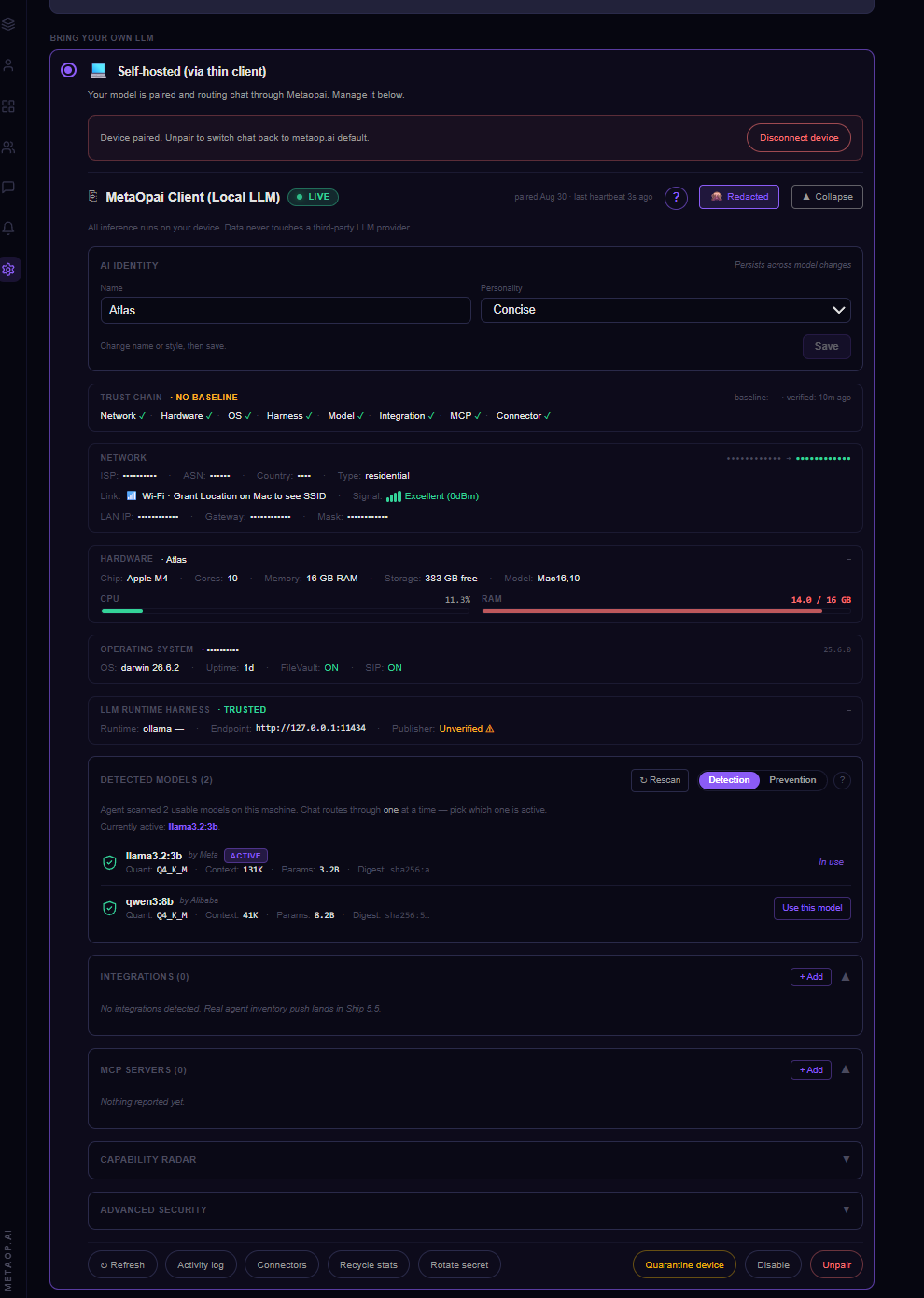
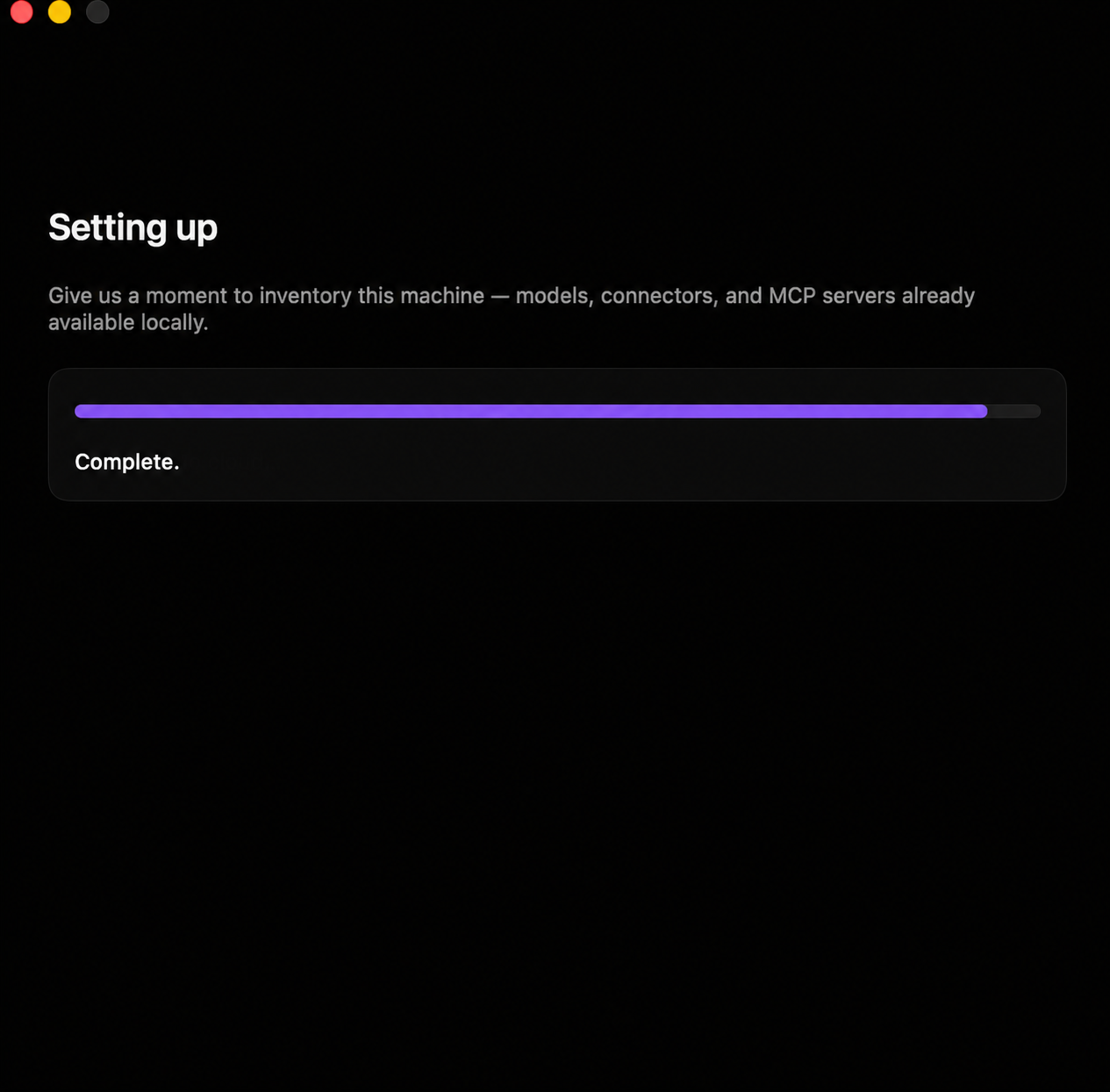
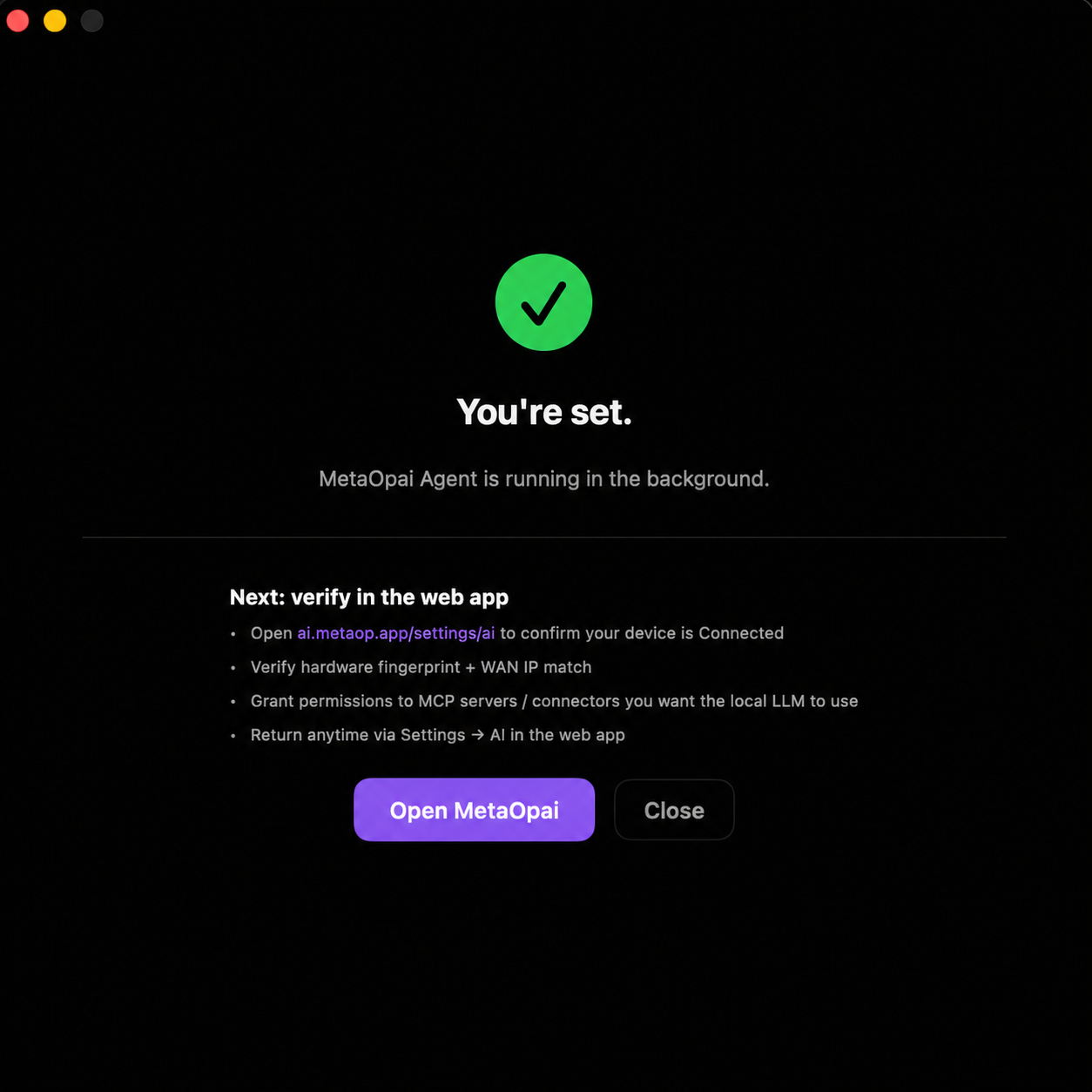
On first run the thin client probes the environment it will operate in and reports it back to your MetaOpai account so you can see and audit it:
- Identity — device signature and pairing to your MetaOpai account
- Network — ISP, ASN, connection type, link quality
- Hardware — chip, cores, memory, storage, live CPU / RAM utilization
- Operating system — version, uptime, FileVault, SIP status
- LLM runtime harness — the local runtime (e.g. Ollama) and its endpoint
- Detected models — every model available locally, with quantization, context window, parameter count, and digest
- Integrations & MCP servers — what the machine already exposes to LLMs on your behalf
You choose which detected model is active. Switching models is a single click.
When an application on your machine exposes tools through MCP (Model Context Protocol), the thin client inventories every tool it advertises. In Prevention mode, newly-discovered tools land in quarantine until you explicitly check them out — like a library that requires a card, with just-in-time access, scope, and duration set per tool.
Detection mode surfaces the same inventory read-only, so you can see what a new install brought in before you decide to grant anything.
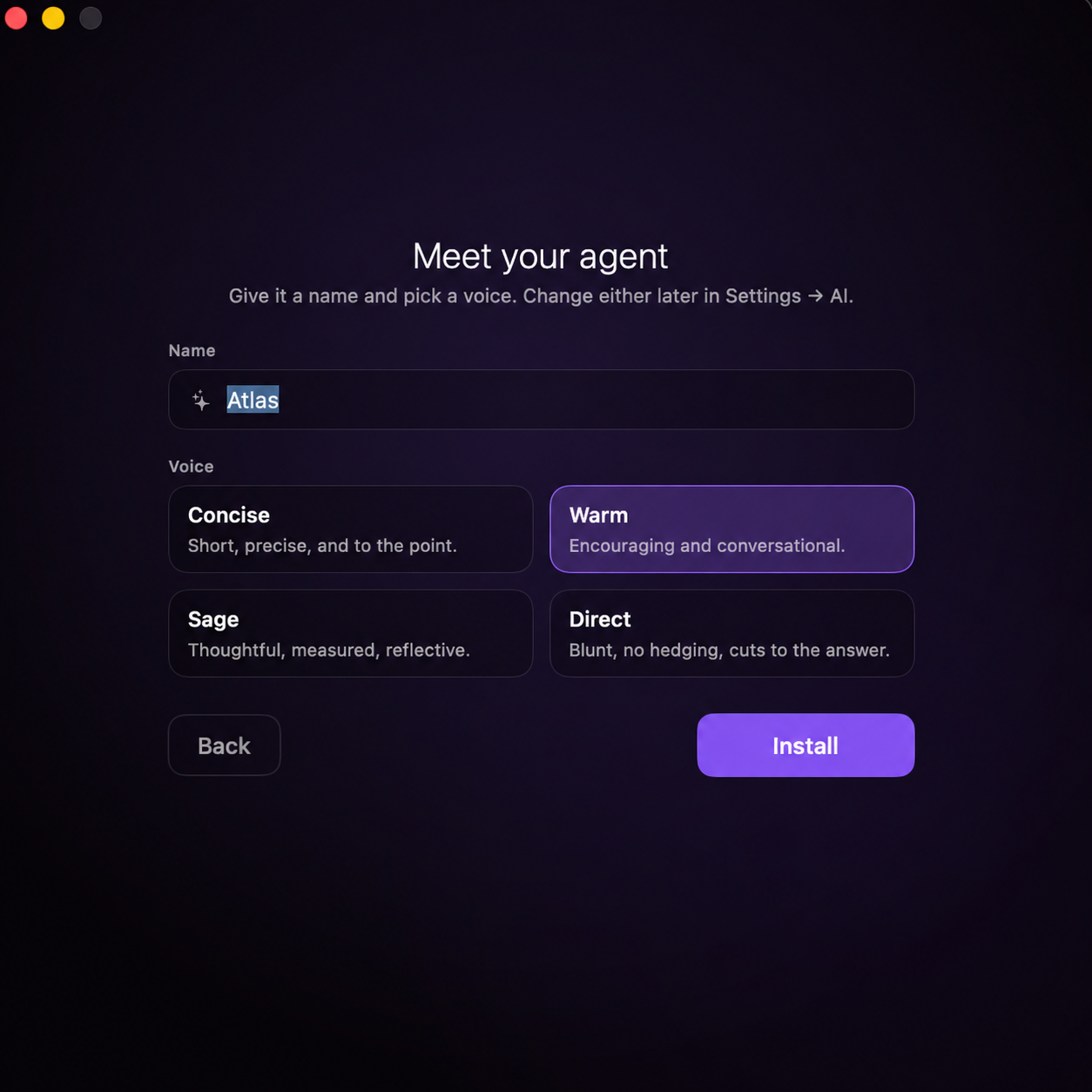
MetaOpai capability-maps your local model — reasoning, context length, multimodal support, tool use — so features that need a particular capability degrade gracefully rather than fail silently. You can also give your LLM a name and a personality; the reasoning stays local, but the operator's experience stays yours.
Your LLM is not allowed to write to or execute against the MetaOpai backend. Reasoning happens on your model; the internal operation of populating context into the KRL is handled by MetaOpai's own custodian LLM. The two responsibilities are separated at the router, so a compromised or hallucinating local model cannot poison your knowledge graph.
You own the artifacts. You control the model. MetaOpai provides the fabric between them — and the safeguards that keep your memory clean.
Export anything. Delete everything.
You can export your MetaopAI data, and if you choose to delete your account, the MetaopAI-held context associated with that account can be removed. Artifacts stored through Bring Your Own Storage remain yours because they were never dependent on MetaopAI storage in the first place.
This separation is intentional:
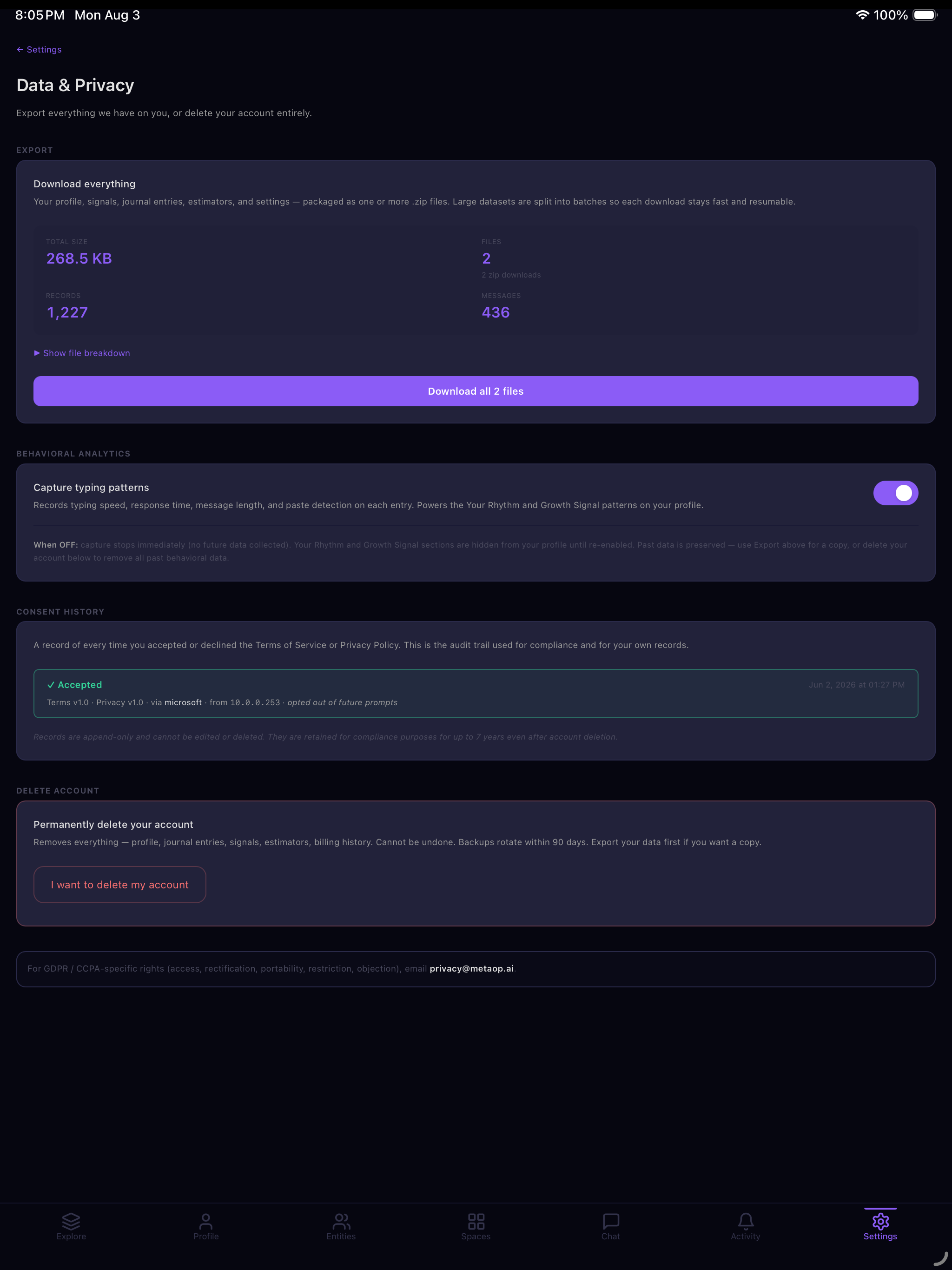
There is also a practical reason. Storing everyone's documents forever creates cost, security exposure, administrative overhead, retention obligations, and additional compliance responsibilities.
As a founder and security engineer, I would rather design MetaopAI so our incentives are aligned with yours. I do not want MetaopAI's business model to depend on accumulating ownership of your personal data.
I want the product to become more useful because it understands your context — not because it possesses your files. There is a refreshing mutual interest in that model: you retain greater control over your information, and MetaopAI carries less unnecessary data liability.
The controls that protect your data.
A compact index of the security and privacy controls that protect your account, your data in motion, your data at rest, and the pipelines that turn narration into structured cognition.
01 · Identity & Sessions
- Passwords hashed with bcrypt; never stored or transmitted in plain text.
- OAuth (Apple, Google, Microsoft), email one-time codes, and Sign-in with Apple supported side by side.
- Every token carries a platform claim; a web token can't be replayed against the mobile API and vice versa.
- Signing out actually invalidates prior tokens — no ghost sessions.
02 · Data In Transit
- HTTPS/TLS on every public endpoint, terminated at the edge.
- Thin-client prompts protected by envelope encryption (X25519 + XSalsa20-Poly1305) — the cloud is a blind relay of prompt content.
- Cloudflare TLS leaf certificate pinned into the macOS agent by SubjectPublicKeyInfo hash.
03 · Data At Rest
- Postgres and Redis reachable only via private endpoints inside the app's VNet — no public network path.
- Secrets live in Key Vault behind Managed Identity; no credentials shipped to containers.
- OAuth provider tokens encrypted at rest.
- Uploaded artifacts stay in the user's own cloud storage (Google Drive, Dropbox, iCloud). MetaopAI keeps references, not bytes.
04 · Custody Firewall
- An ephemeral quarantine table stages every proposed KRL write before it lands.
- OWASP-style scan strips exe/archive/base64/injection payloads before they reach the model.
- A signed HMAC promotion marker gates the ephemeral → durable transition; direct writes are refused at the router.
- Extraction always runs on MetaopAI's custodian model — never on a user's BYO or thin-client model.
05 · Thin Client & Local LLM
- macOS installer is signed and notarized by Apple; Gatekeeper trust out of the box.
- Outbound-only encrypted WebSocket — no inbound ports opened on your machine.
- Optional static-IP whitelist and per-device pairing token, both rotatable.
- Automatic quarantine when the agent misbehaves (throughput, fingerprint drift, signature failures).
06 · MCP & Tool Governance
- Every tool an MCP server advertises is inventoried on discovery.
- Prevention mode quarantines new tools until the operator explicitly grants access.
- Grants are scoped and time-bounded — like a library card, revocable any time.
- Static shell-eval audit at checkout flags dangerous execution patterns.
07 · Application Boundaries
- Per-user ownership check on every resource query; a compromised session can only see its owner's data.
- Sliding-window rate limits on auth, streaming, and read paths — fail-open so a cache blip is never a prod outage.
- Per-user concurrency cap on streaming turns; back-pressure absorbed by the queue, not by the database.
- A user's LLM cannot write to or execute against the MetaopAI backend — reasoning and system-of-record are separated at the router.
08 · Mobile & App Integrity
- Apple App Attest on iOS: cryptographic attestation from the Secure Enclave.
- Google Play Integrity on Android: JWKS-verified integrity token per device.
- Biometric lock (Face ID / Touch ID / PIN) available for local app entry.
- Pre-flight capability probe before any secure operation runs.
09 · Observability & Audit
- Per-turn cognition trace: which context was loaded, which model saw it, what came back.
- Tamper-evident thin-client activity log, exportable to Notes.
- Append-only consent log for every privacy-affecting decision.
- Structured JSON logging with correlation IDs across every request.
10 · Sharing & Public Access
- Public share links are tokenized, rate-limited, and optionally password-protected.
- Expiries at 7 / 14 / 30 days available; links can be revoked at any time.
- Shares can be pinned to a specific note version — later edits stay private.
- Media served to a public viewer is proxied, never handed a permanent BYO storage URL.
11 · Third-Party Providers
- Chat reasoning on BYO providers runs under your provider terms and API key.
- Signal extraction and pattern detection never touch a third-party model — always MetaopAI custodian.
- Optional Tavily research lookups are opt-in, kill-switchable, and clearly labeled in the UI.
- External research fails open: if a lookup service is unreachable, your session continues.
12 · Privacy Guarantees
- One-click export of your MetaopAI-held data.
- Account deletion removes the context we hold; your BYO storage artifacts remain untouched.
- Behavioral metrics (typing speed, spelling patterns) are opt-in and clearly labeled as signal inputs — not surveillance.
- We do not sell, rent, or share your data with advertisers or data brokers.
This is a public summary. Implementation details that would materially help an attacker (exact thresholds, keys, internal endpoint layouts) are intentionally omitted. If you are a researcher, auditor, or enterprise customer who needs deeper documentation under NDA, contact us.