A private intelligence that listens, remembers, and models context across the relationships in your life — and surfaces the patterns no one else can see. Not advice. Not verdicts. Just clearer signal.
MetaopAI is a private journal paired with an AI signal intelligence engine that turns your everyday narrations about life — yourself, the people around you, your environments, and your relationships — into structured, persistent signals. Instead of treating entries as disposable chat messages that get lost in context-window collapse, the system extracts behaviors, events, emotional framing, and relationship dynamics, then stores them in a governed Knowledge Representation Layer (KRL) organized across four clear scopes: USER, ENTITY, SPACE, and RELATIONSHIP_PAIR.
Over time, MetaopAI's Pattern Engine correlates these signals to surface meaningful patterns — trust cycles, withdrawal loops, reciprocity shifts, repair-and-relapse rhythms — with evidence, confidence scores, and provenance, never judgment. It sits in the gap between a partner (context but no neutrality), a friend (neutrality but no confidentiality), a therapist (expertise but limited scale), and a general-purpose AI (intelligence but no real memory). The result is true continuity that compounds for months and years, so you're finally understood by a system that actually remembers and makes sense of your real life.
Be understood. Operate with clarity.
A friend who's pulling away. A manager whose tone shifted last month. A partner whose evenings feel a little different lately. You sense something — but you can't quite name it. So you reach out for help.
Today, you have four choices. None of them are built for this.
The thing you actually want is something that holds your story — that listens carefully, remembers precisely, and tells you what it sees over time. Without bias. Without verdicts. Without forgetting.
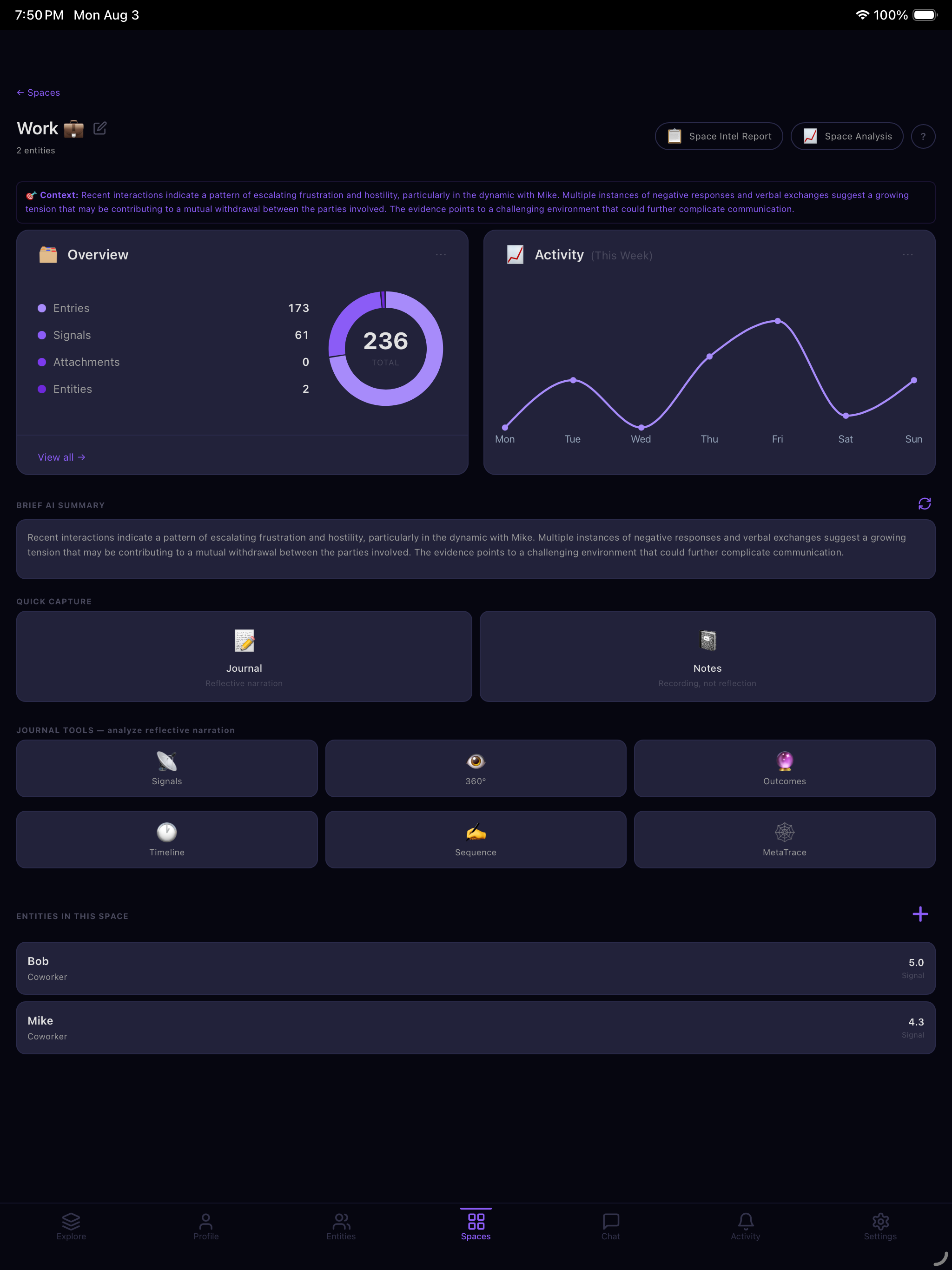
MetaopAI is an AI-powered journal with signal intelligence, organized around Spaces. A Space represents an area of your life you want to reflect on and understand over time — work, family, a relationship, a project, a city, or any environment with its own people, dynamics, and context.
Each Space contains three core components: a Journal where reflection happens, Notes where you develop ideas and work with information, and Entities — the people assigned to that Space.
As you continue using a Space, its context compounds. Events, people, relationships, observations, and prior reflections build on one another, giving MetaopAI a richer model of that environment over time. With that accumulated history, the AI can analyze what you narrate, surface hidden signals and recurring patterns, and reveal connections or meanings that can help shape how you interpret what is happening.
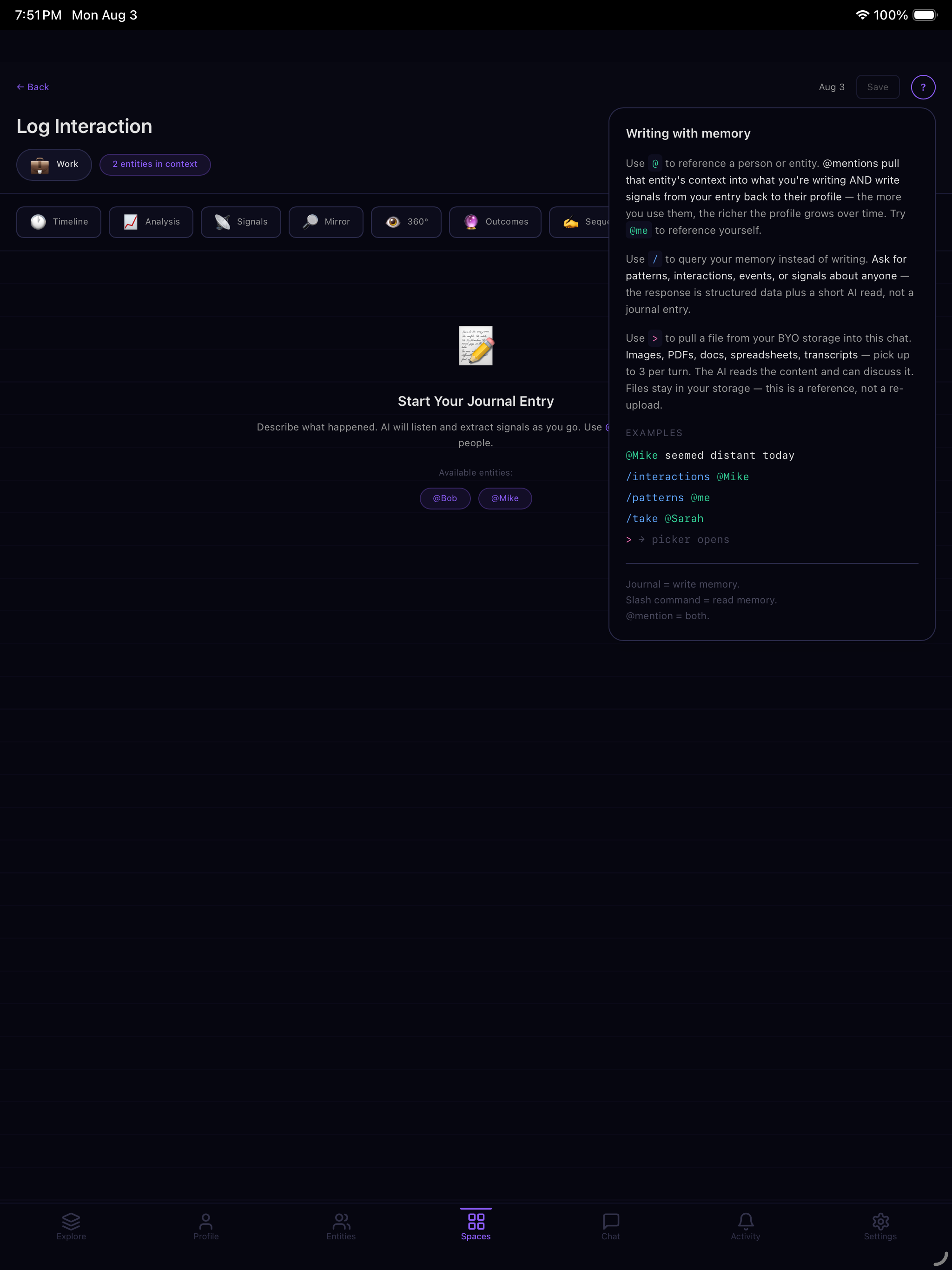
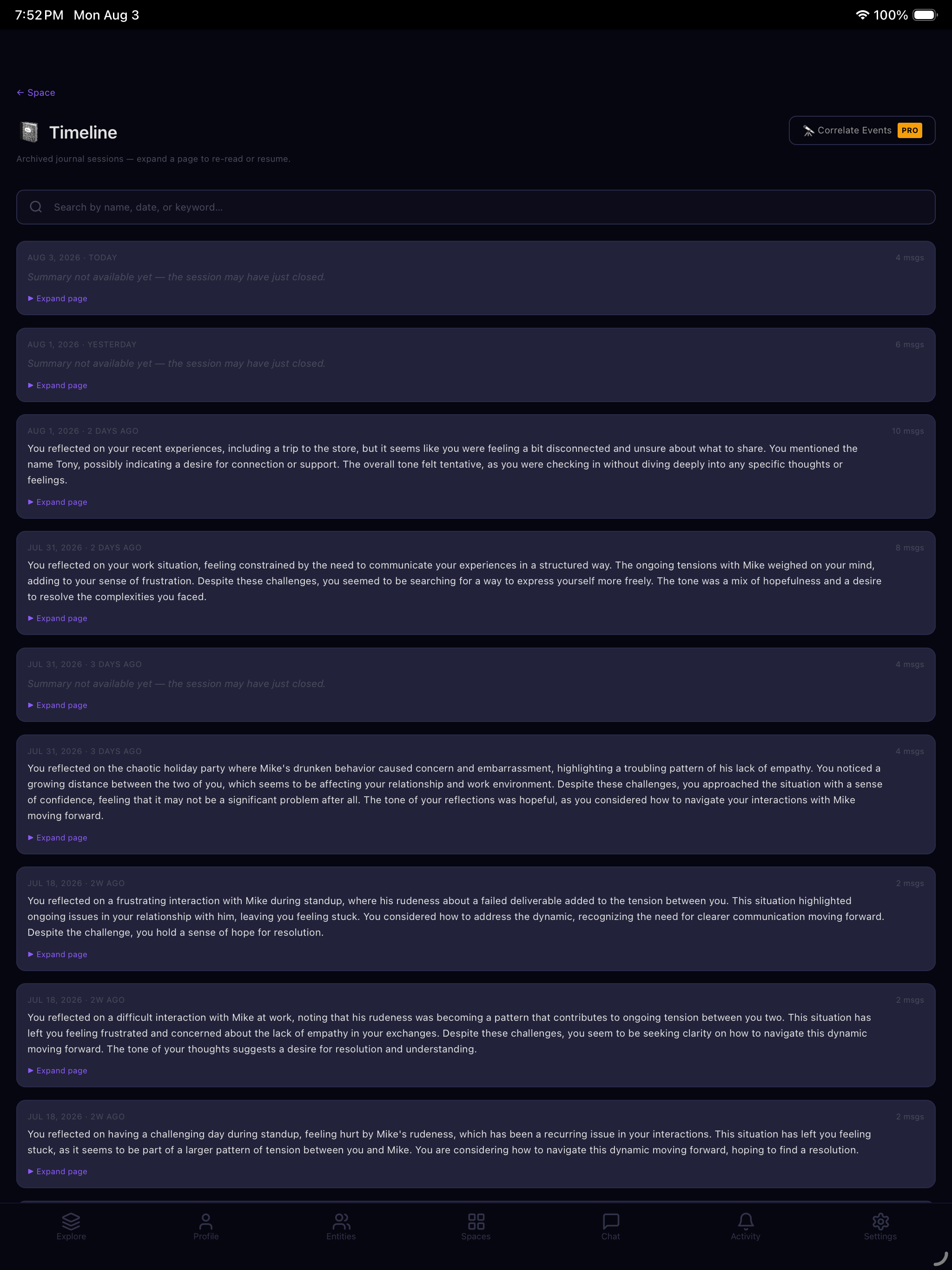
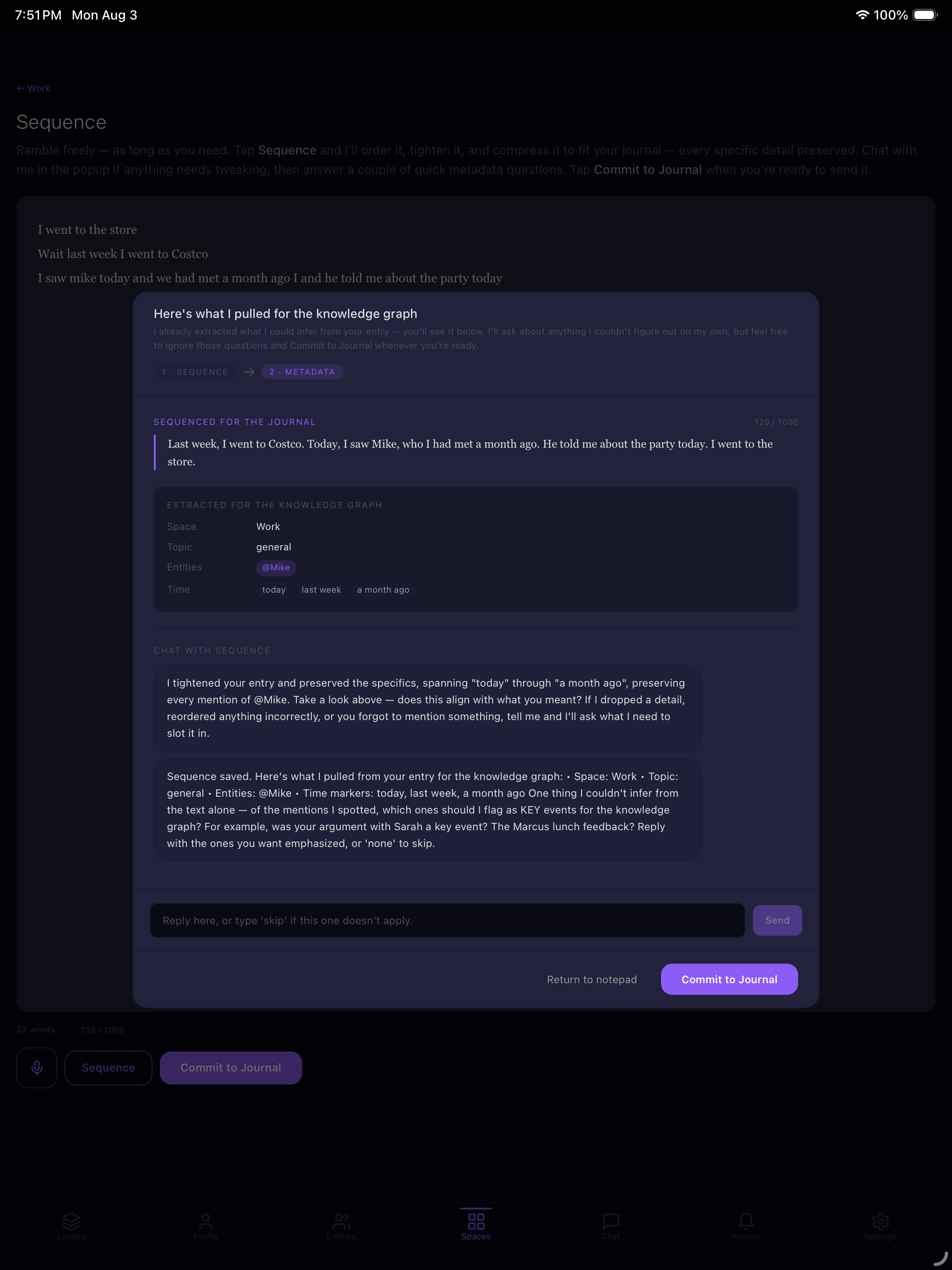
Inside each Space is a Journal where you narrate what happened, what you noticed, how an interaction felt, what changed, or anything else you want to think through.
MetaopAI reads that narration analytically. It looks across what has already been captured in the Space — including prior events, people, relationships, signals, and patterns — and uses that history to help interpret what you are describing now.
Because each new reflection builds on what came before, the Journal does not behave like a series of isolated AI conversations. Its understanding compounds over time, allowing new events to be examined against the history surrounding them.
The result is a journal that not only remembers what you wrote, but can help surface recurring behavior, emerging signals, hidden patterns, and changes in the dynamics of the Space as they develop.
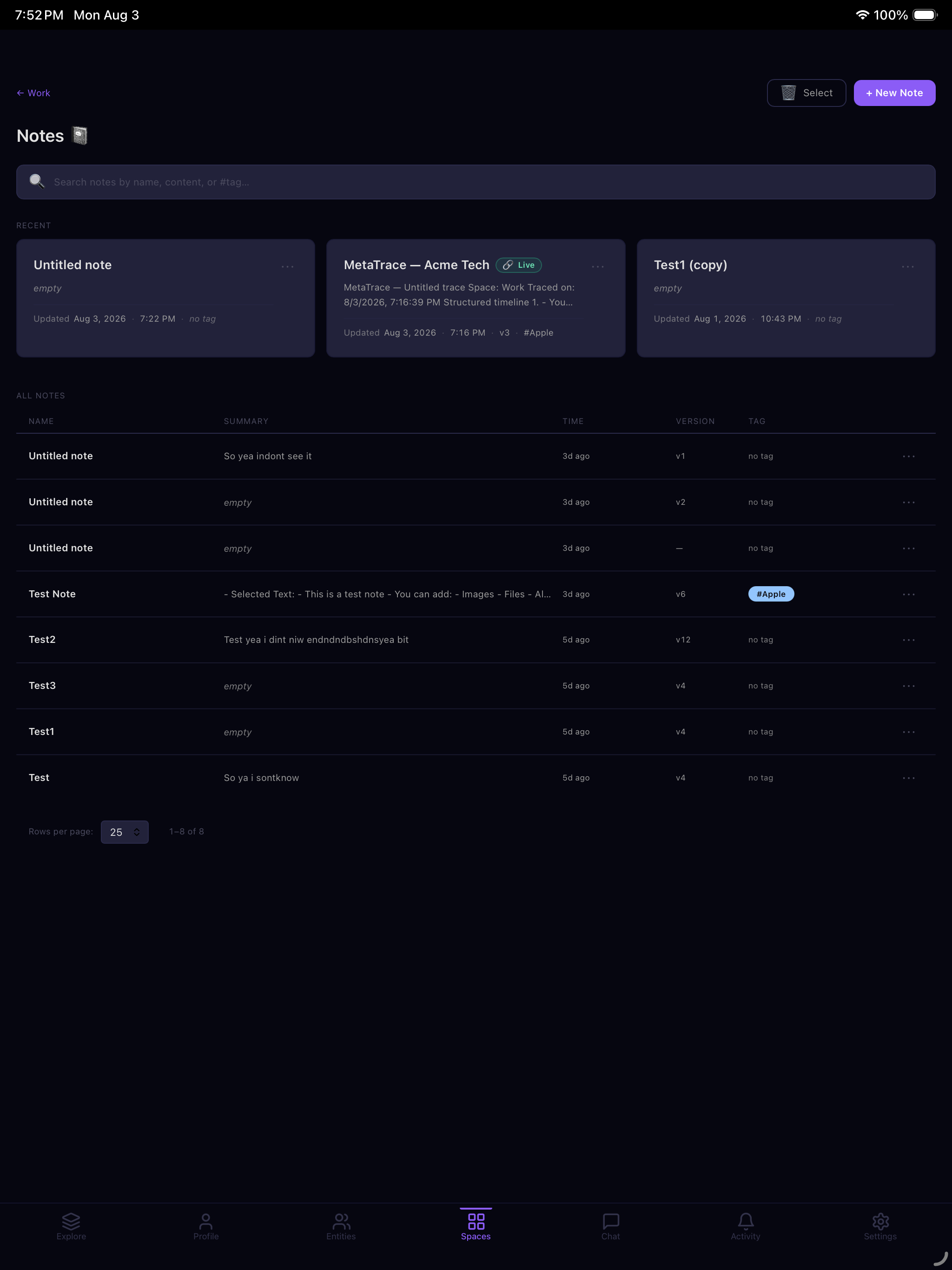
Unlike the Journal — which is designed for narration and reflection — Notes give you a flexible AI-powered workspace for creating, collecting, organizing, and working with your own material.
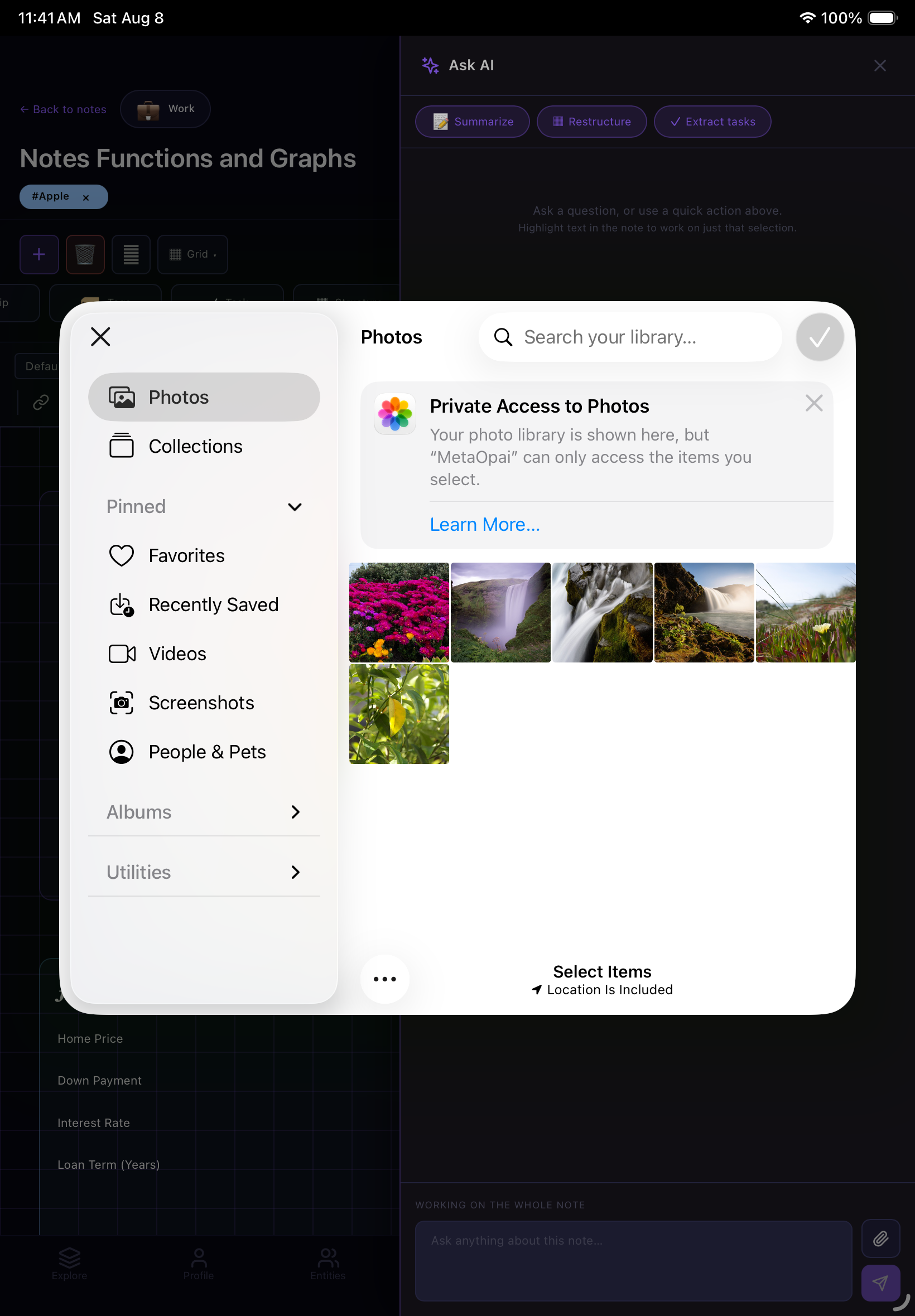
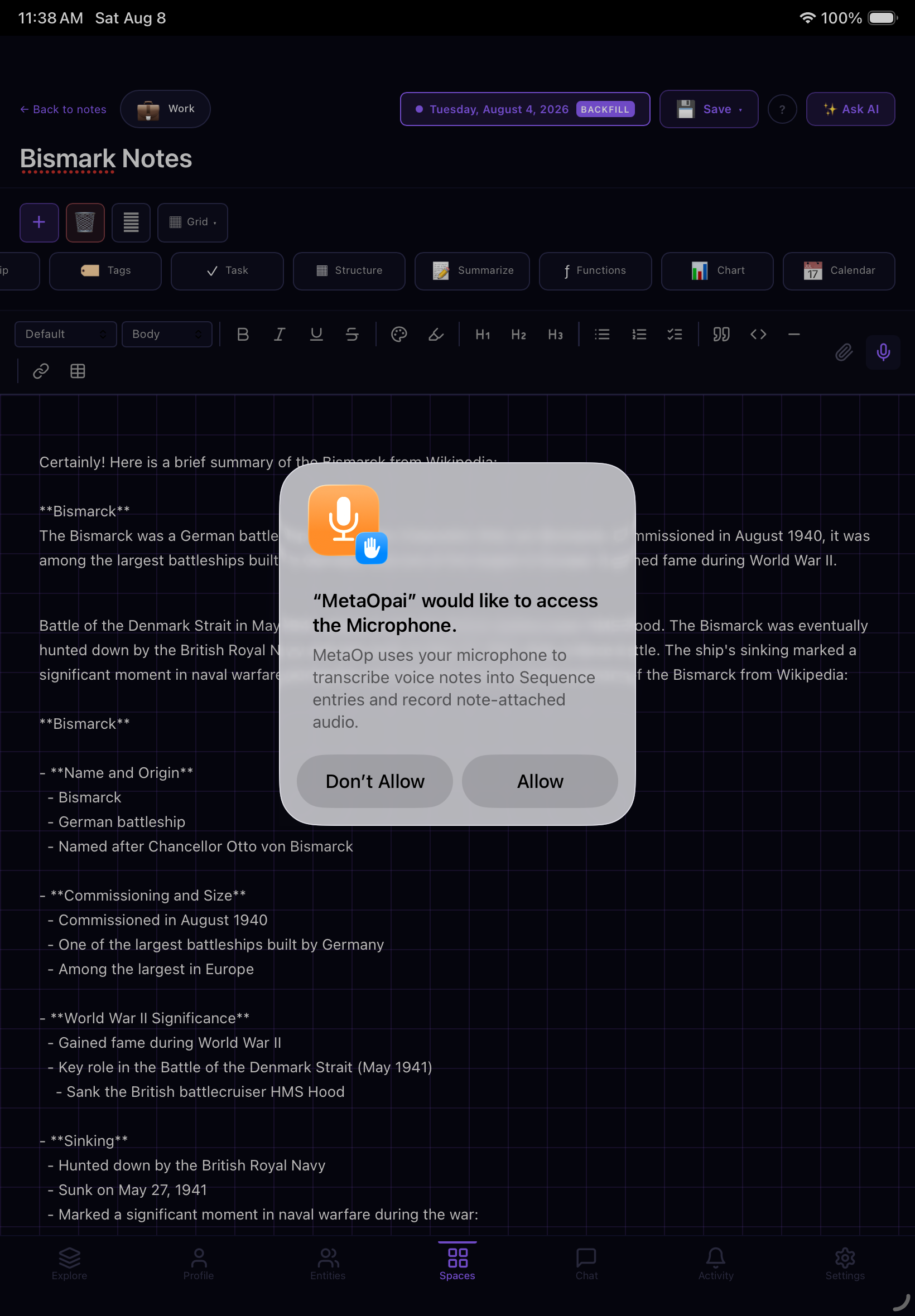
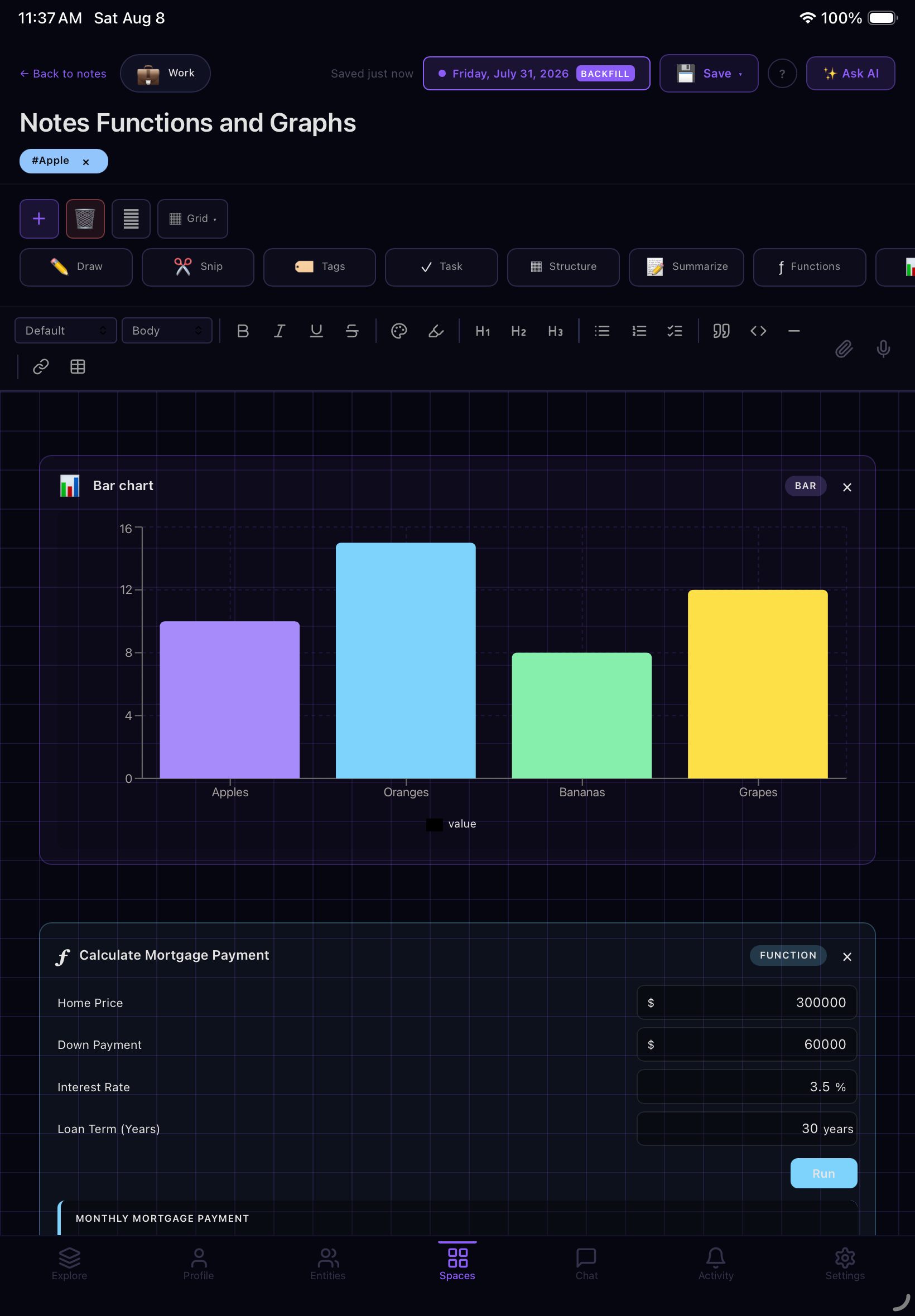
A Note can be simple text or something much richer. Upload PDFs, Word documents, PowerPoint presentations, spreadsheets, and text files; insert images; record voice with transcription; draw; and create graphs, tables, charts, and functions.
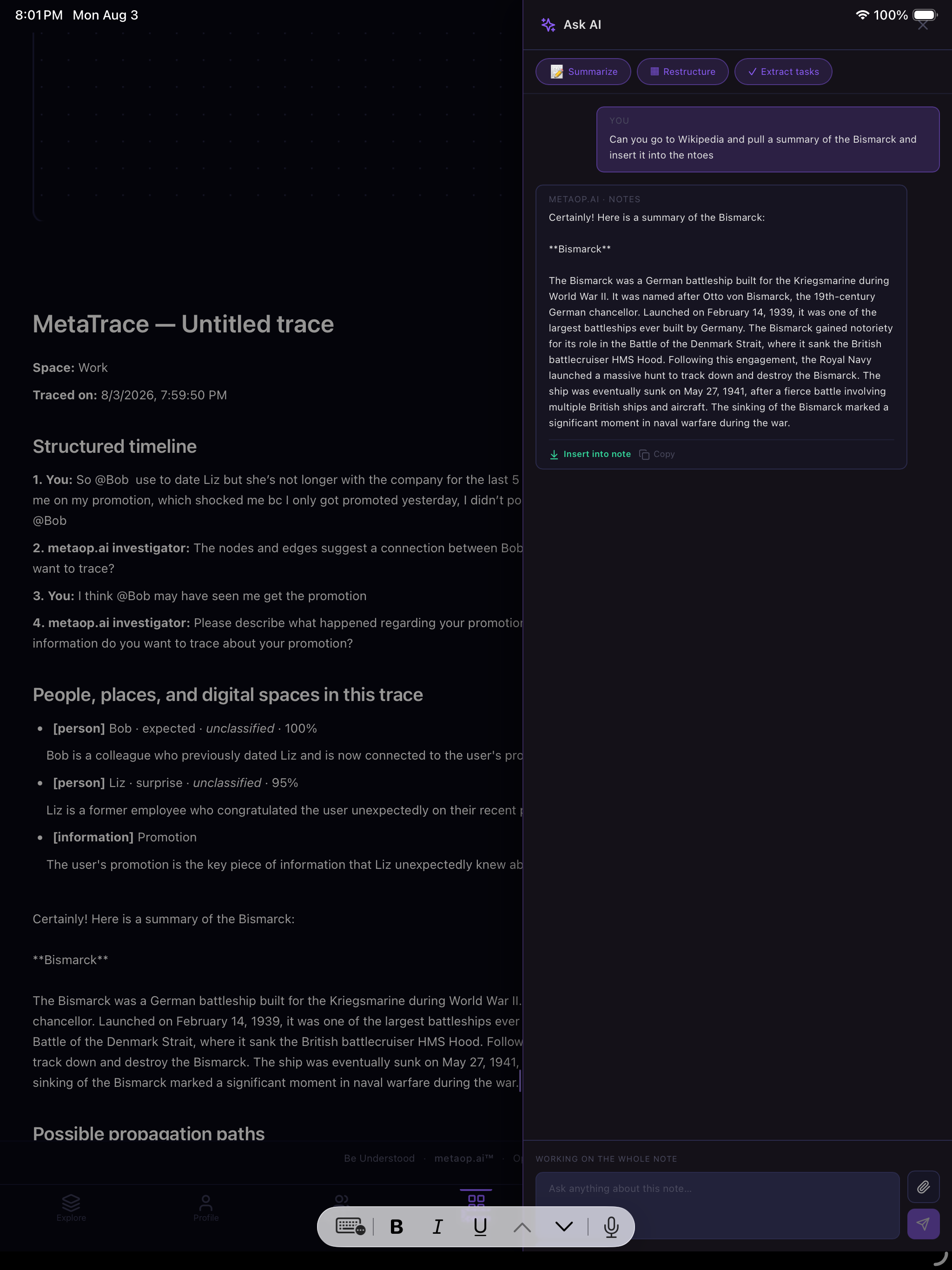
AI works alongside you inside the Note. Ask it to research and insert information, summarize material, extract tasks, structure unorganized thoughts, or help you work directly with the data and content you've collected.
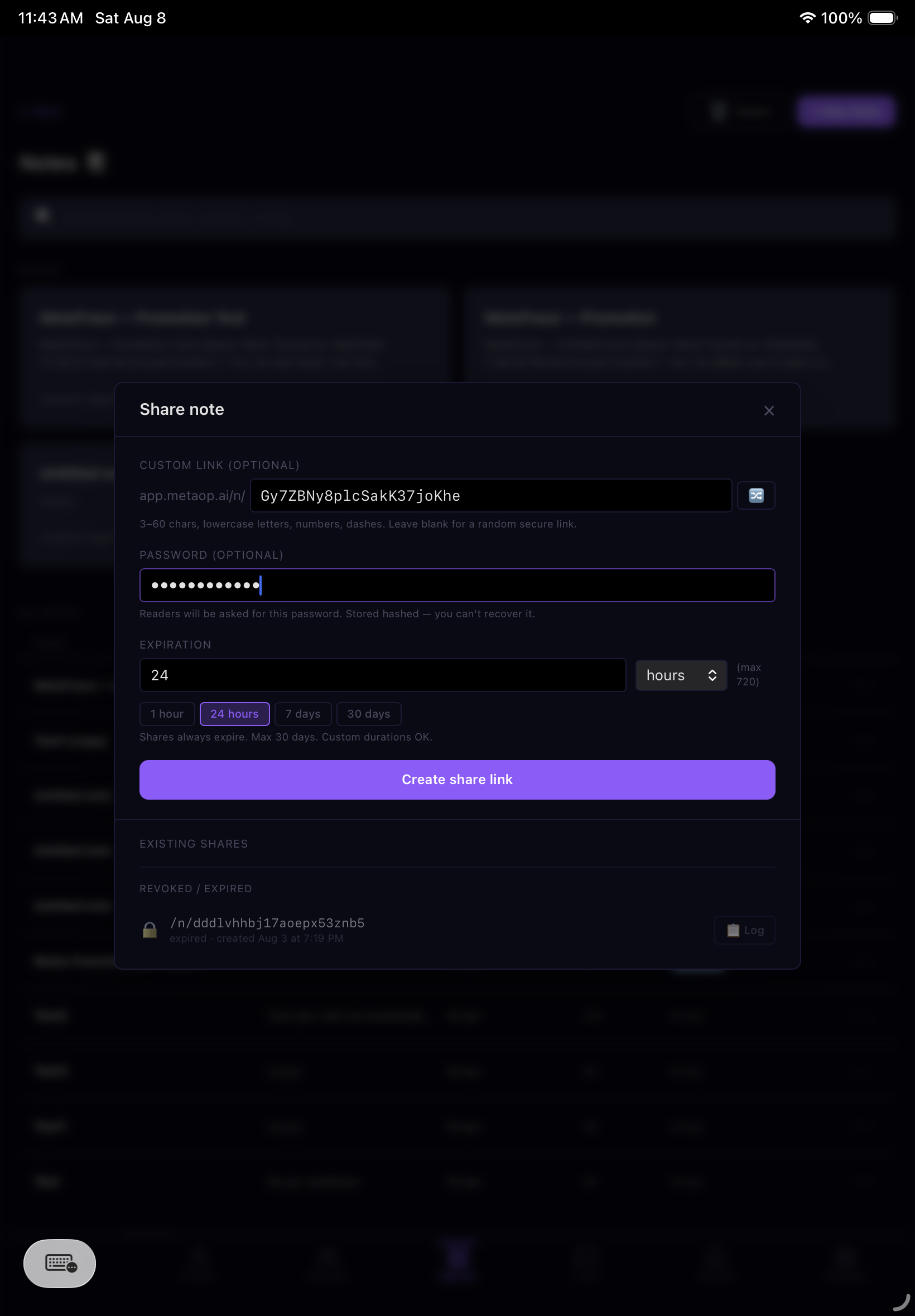
Your Notes remain yours. They can be saved locally or to your own cloud storage, giving you control over where your information lives. When you need to share something, a Note can be sent outside MetaopAI through a time-sensitive, password-protected link. Sharing is logged so you have a record of what was shared, when it was accessed, and its history — providing confirmation of reception and an auditable trail.
The Journal is where you reflect on your world. Notes are where you build, organize, analyze, and share the information within it.
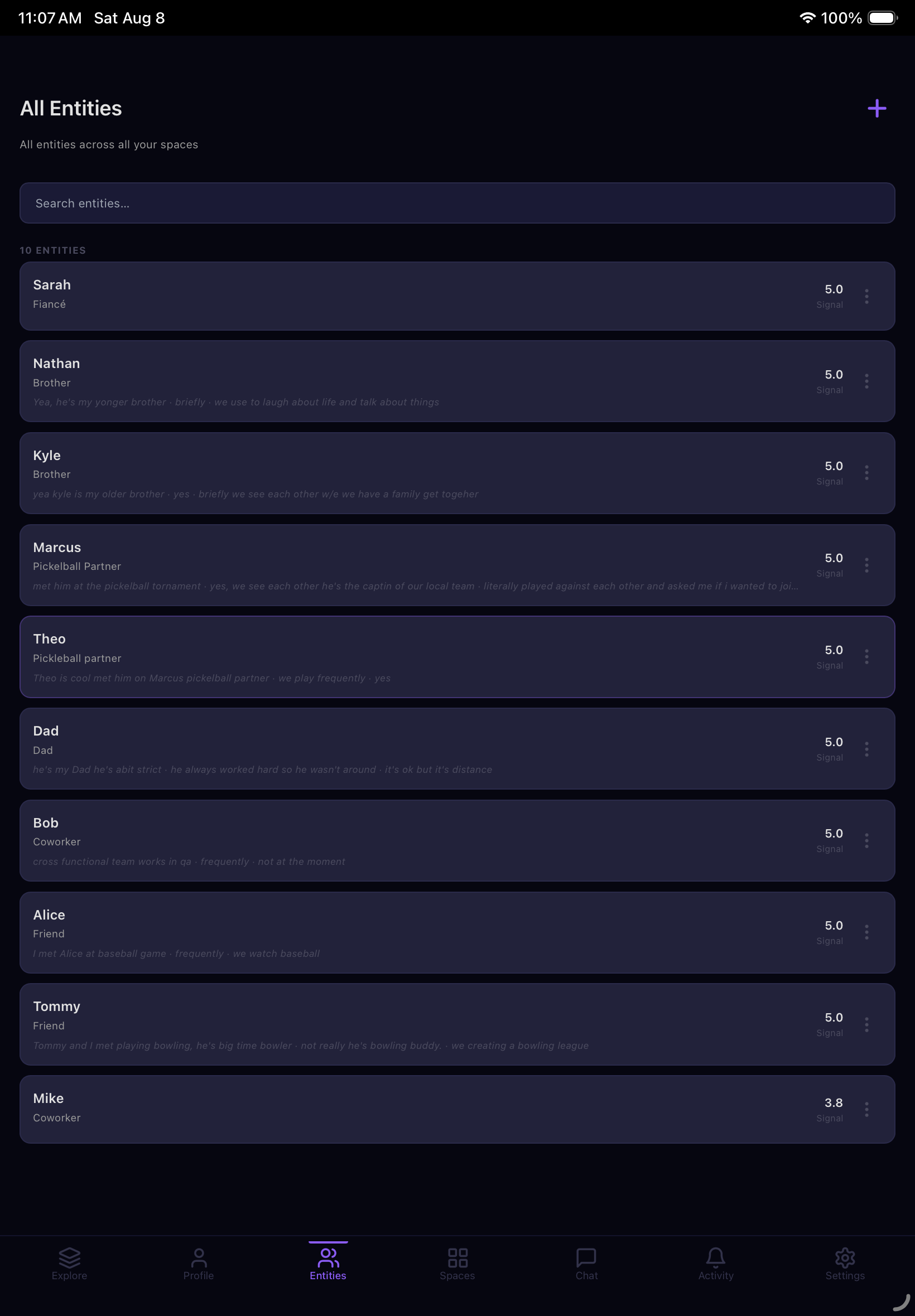
An Entity can exist globally in your MetaopAI, but before you can reference that person inside a Journal, the Entity must first be assigned to the Space.
Think of it like placing a chess piece onto a board — the person exists independently, but assigning them to a Space places them into that particular context and makes them available to invoke while journaling.
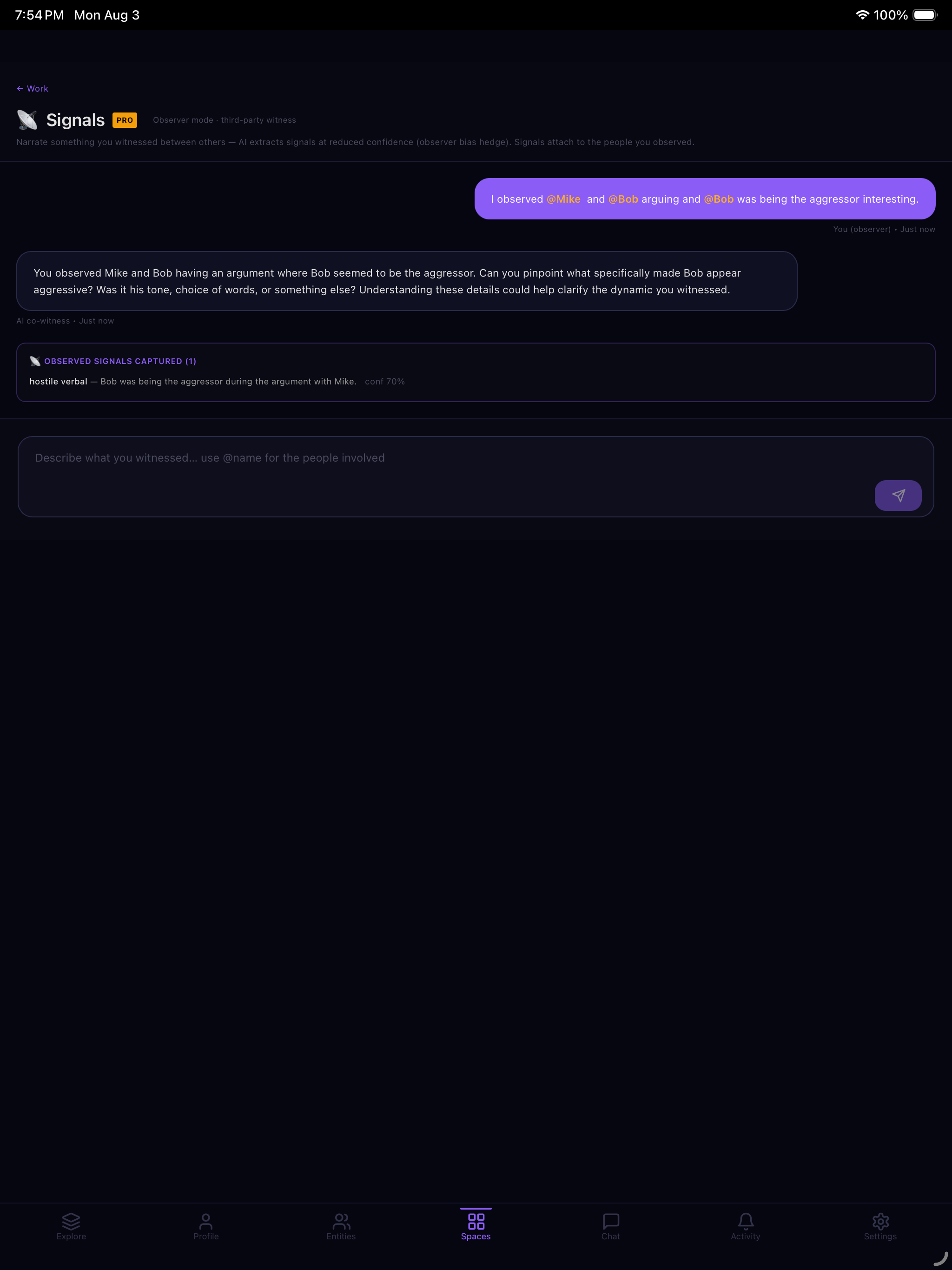
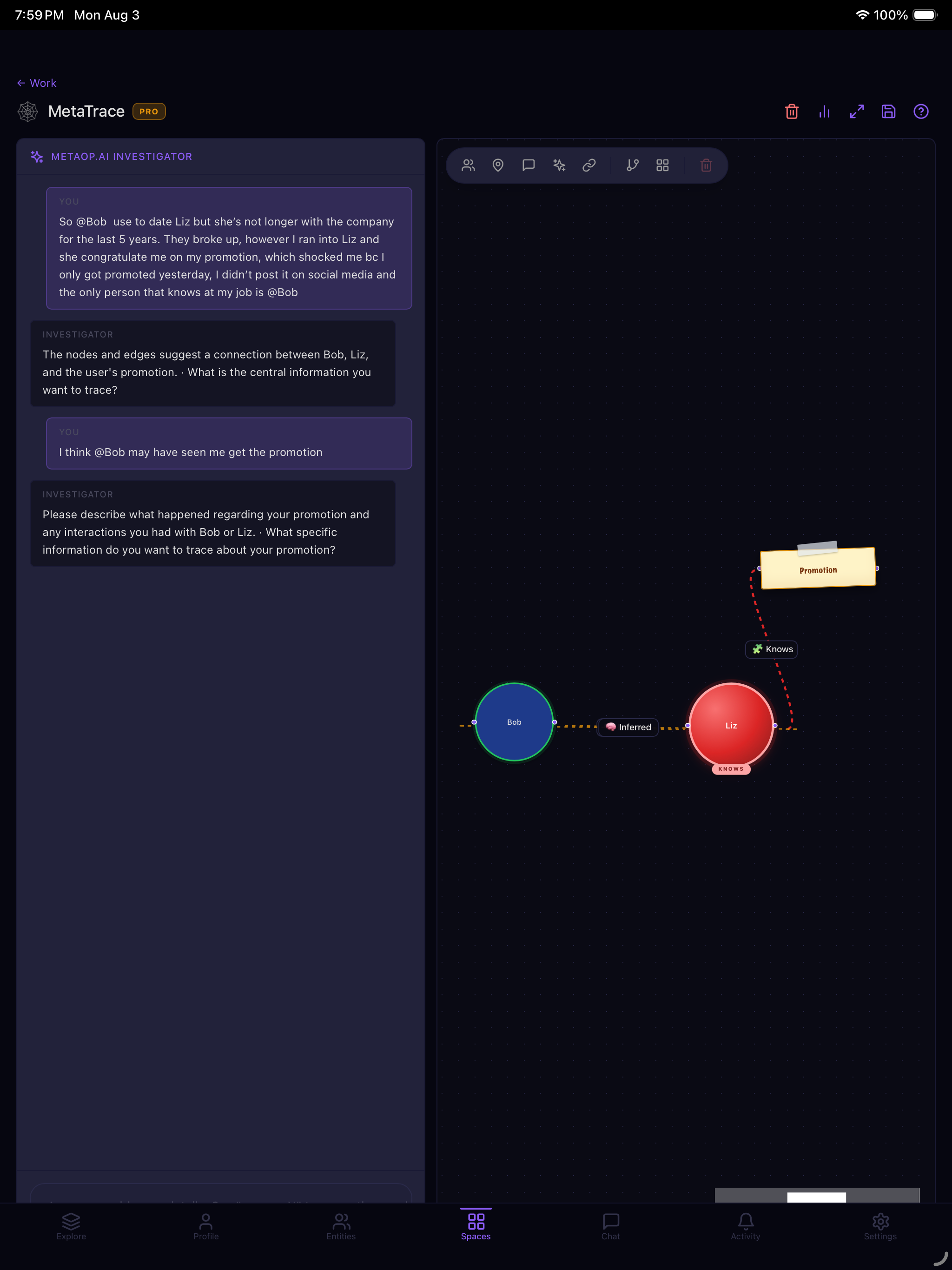
When you reference someone with @Entity, MetaopAI invokes that person into the current Journal conversation. You narrate the event, interaction, relationship, or behavior, and MetaopAI parses what you wrote to identify the context, signals, and patterns relevant to that person. Those observations are then associated with the Entity's profile.
Over time, the profile grows. New events are appended, recurring signals can become patterns, and previous context remains retrievable rather than disappearing as the Journal continues to evolve.
If something happens with the same person a month later, simply invoke @Entity again. MetaopAI retrieves the relevant prior context and analyzes the new event alongside what was already known.
The history is not lost just because the Space has continued to grow.
An Entity exists globally in your MetaopAI account and can be assigned to multiple Spaces — but the context associated with that Entity remains locked to the Space where it was observed.
If the same person appears in your Work Space and your Family Space, MetaopAI does not automatically blend those two histories together. Each Space maintains its own history of that relationship and the observations made within that environment.
This prevents context from bleeding between unrelated parts of your life — the same Entity can be placed on different boards, while each Space preserves its own history with them.
A Space is an area of your life you're reflecting on. Every Space develops its own context — the people in it, the relationships between them, the unspoken rules, recurring behaviors, atmosphere, and overall vibe of that environment. As you continue narrating, MetaopAI builds a richer model of how that Space operates over time.
The Journal is where you narrate and reflect on what is happening inside that Space.
Notes are the AI-powered workspace where you create, organize, analyze, and work with your own information.
Entities are the people assigned to the Space. Their observations, signals, patterns, and history can grow as new events occur and be retrieved when that person is referenced again.
When you invoke @Entity while journaling, MetaopAI brings that person's existing context from the current Space into the reflection, allowing the new event to be understood alongside what you've already observed.
Together, these pieces give MetaopAI continuity: the Space preserves the environment, the Journal captures what happens within it, Notes help you work with your information, and Entities preserve the people moving through that world.
Tools built around the way you reflect and work.
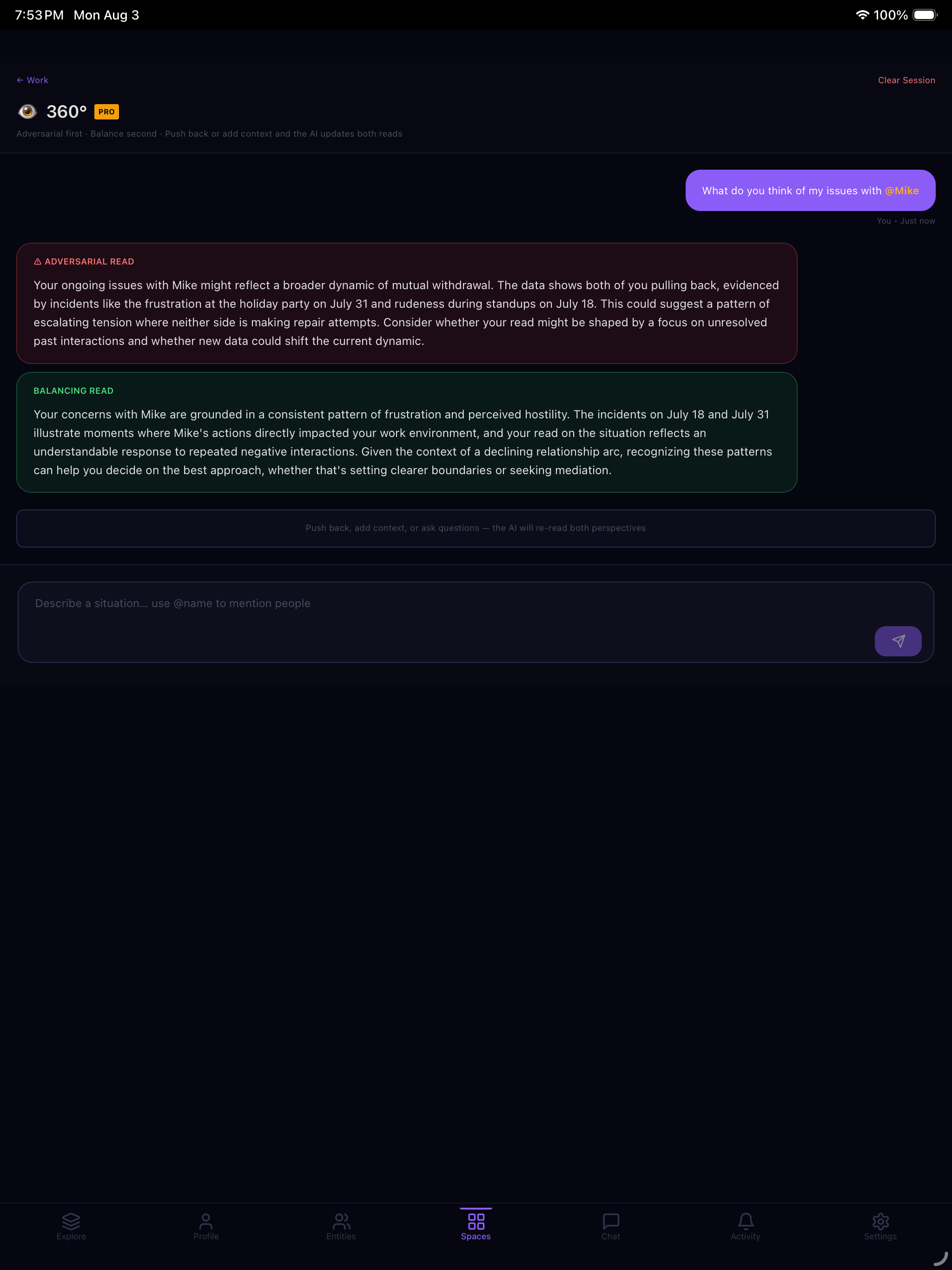
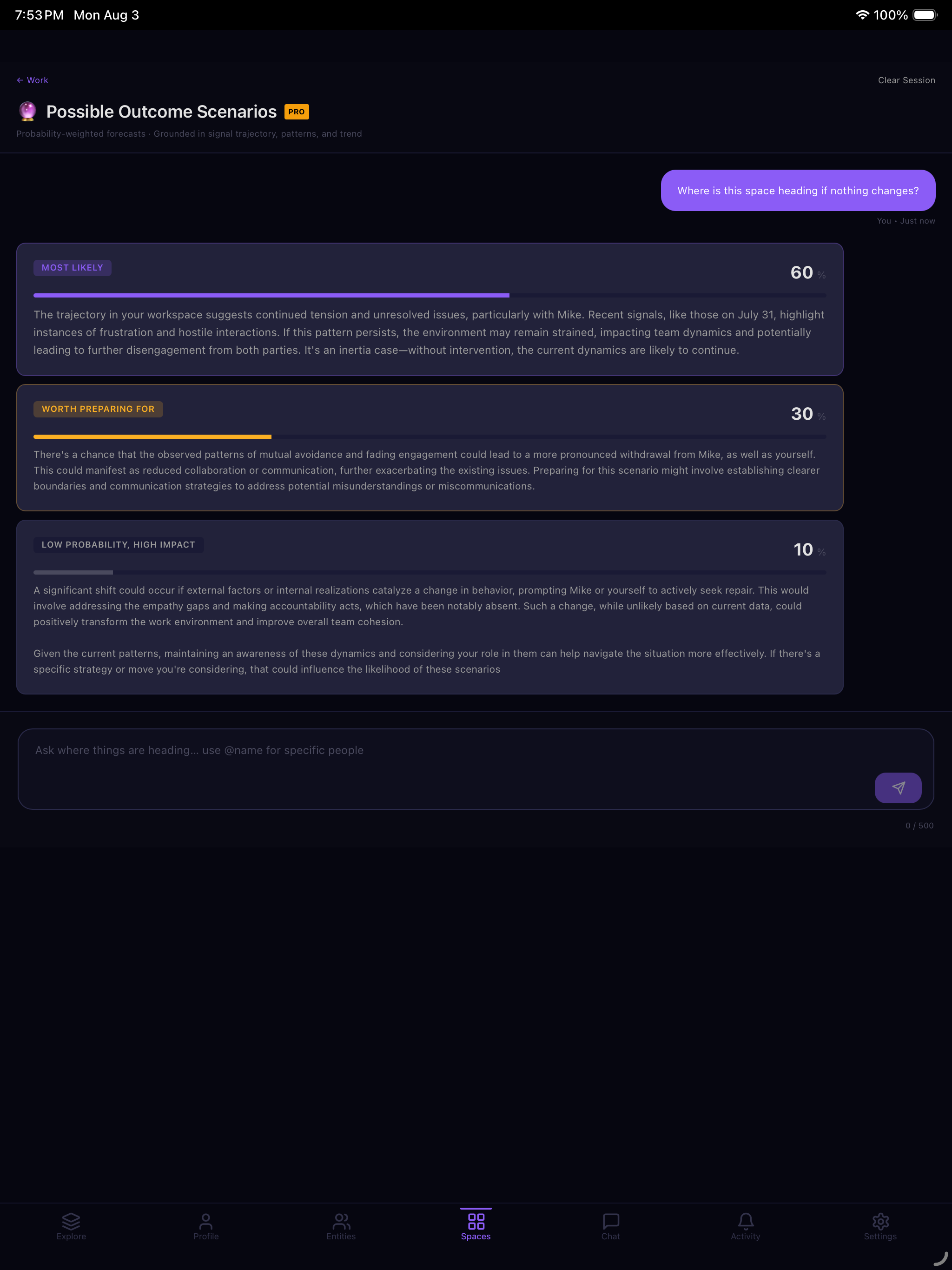
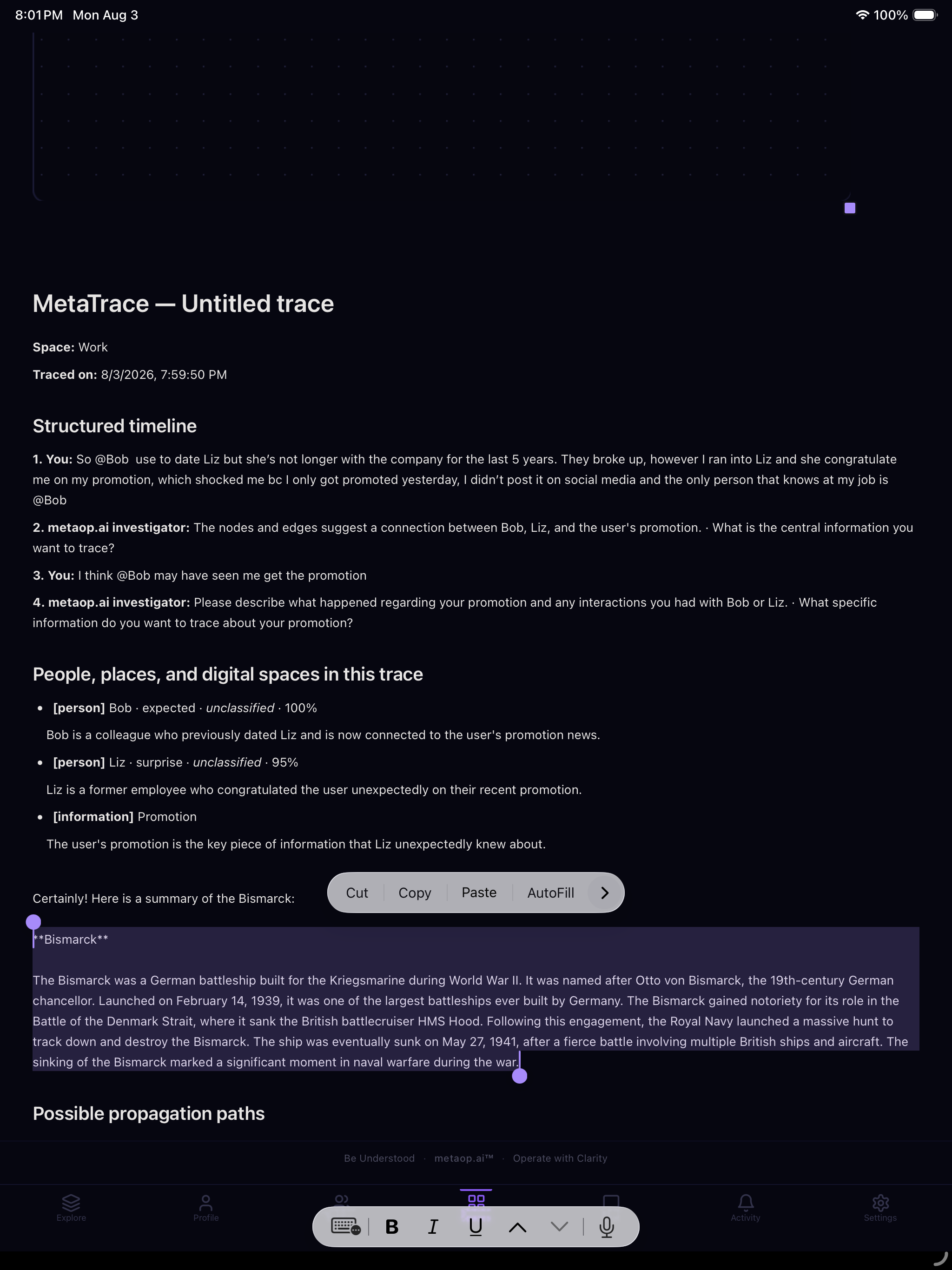
The Journal is where you narrate experiences, interactions, observations, and change. As the history of a Space grows, MetaopAI preserves that context and gives you six analytical tools for examining what you've recorded.
Notes are the working surface inside a Space. Create from scratch or bring in existing material, then use AI and rich editing tools to organize, transform, analyze, and share it.
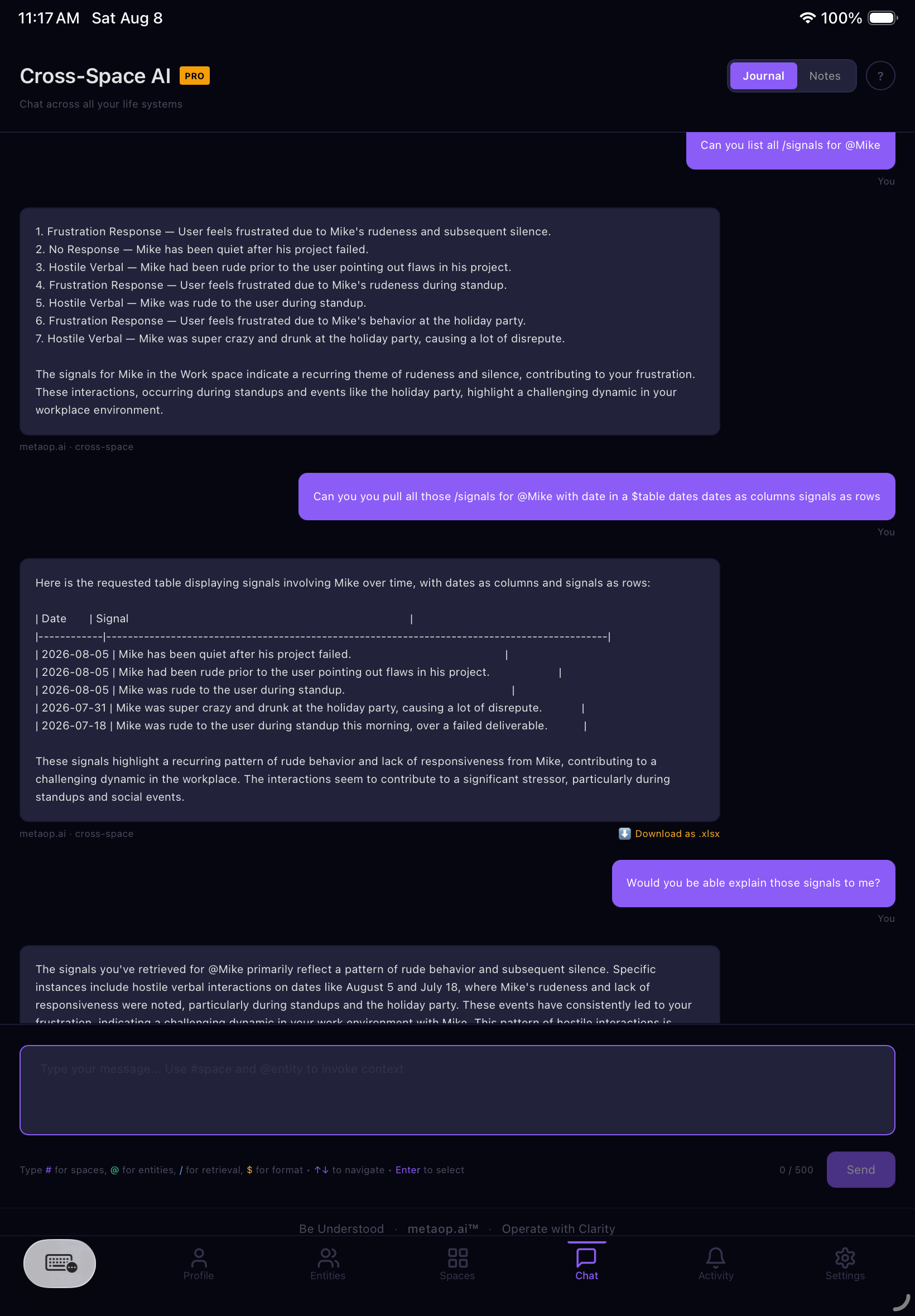
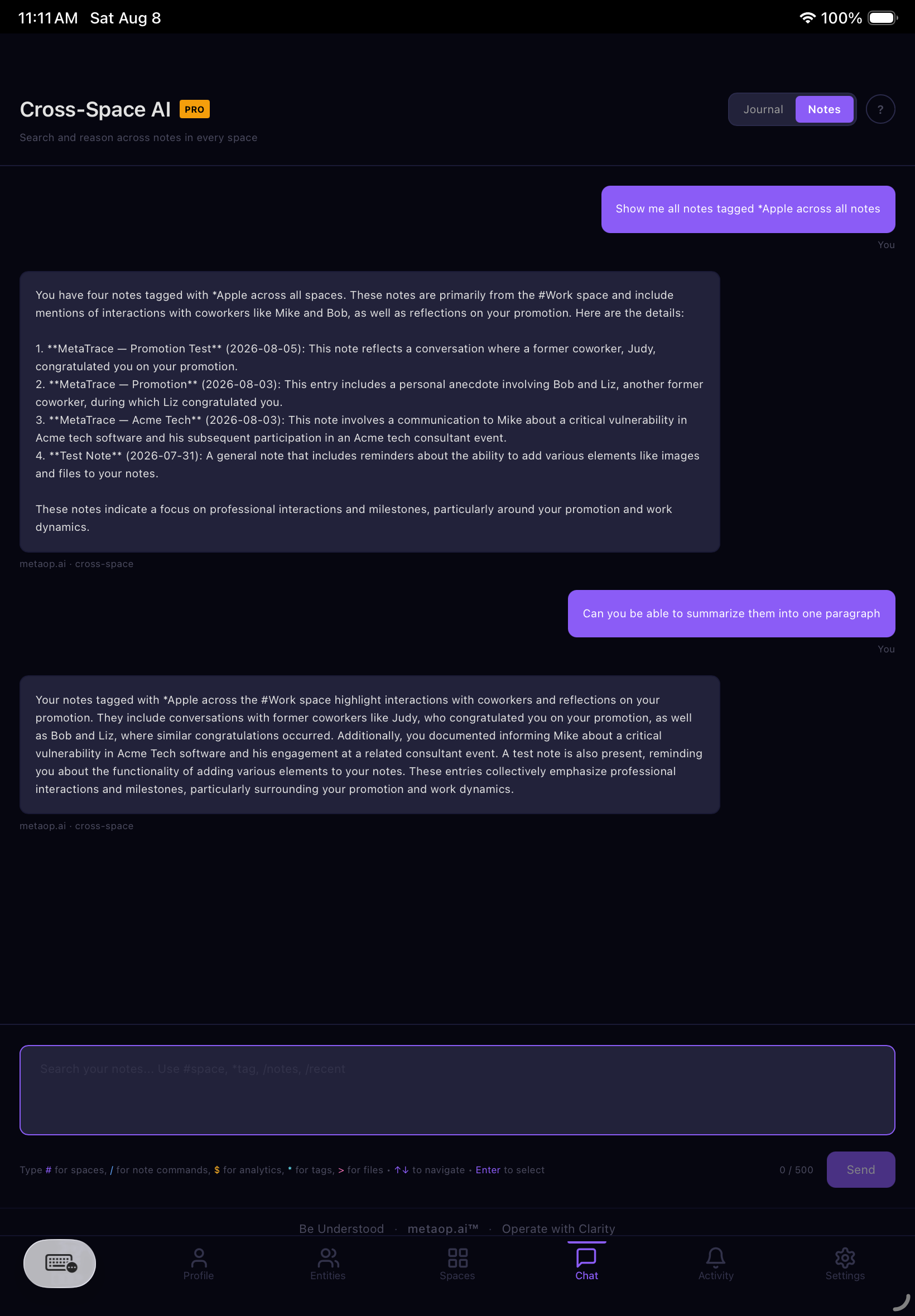
Cross-Space is the only surface where entries and queries span every Space at once. Two modes share one mental model:
Journal = write memory. Slash command = read memory. @mention = both.
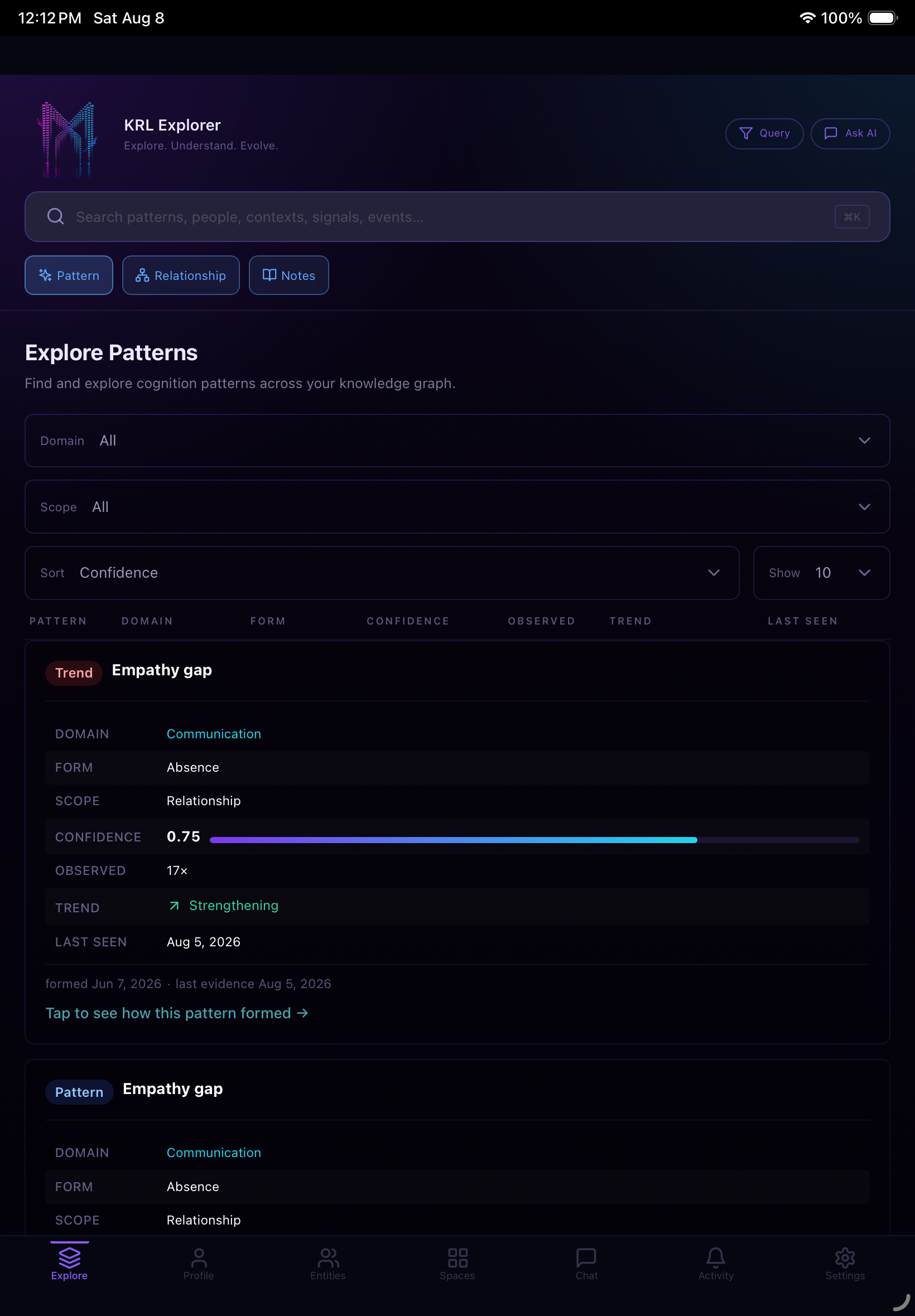
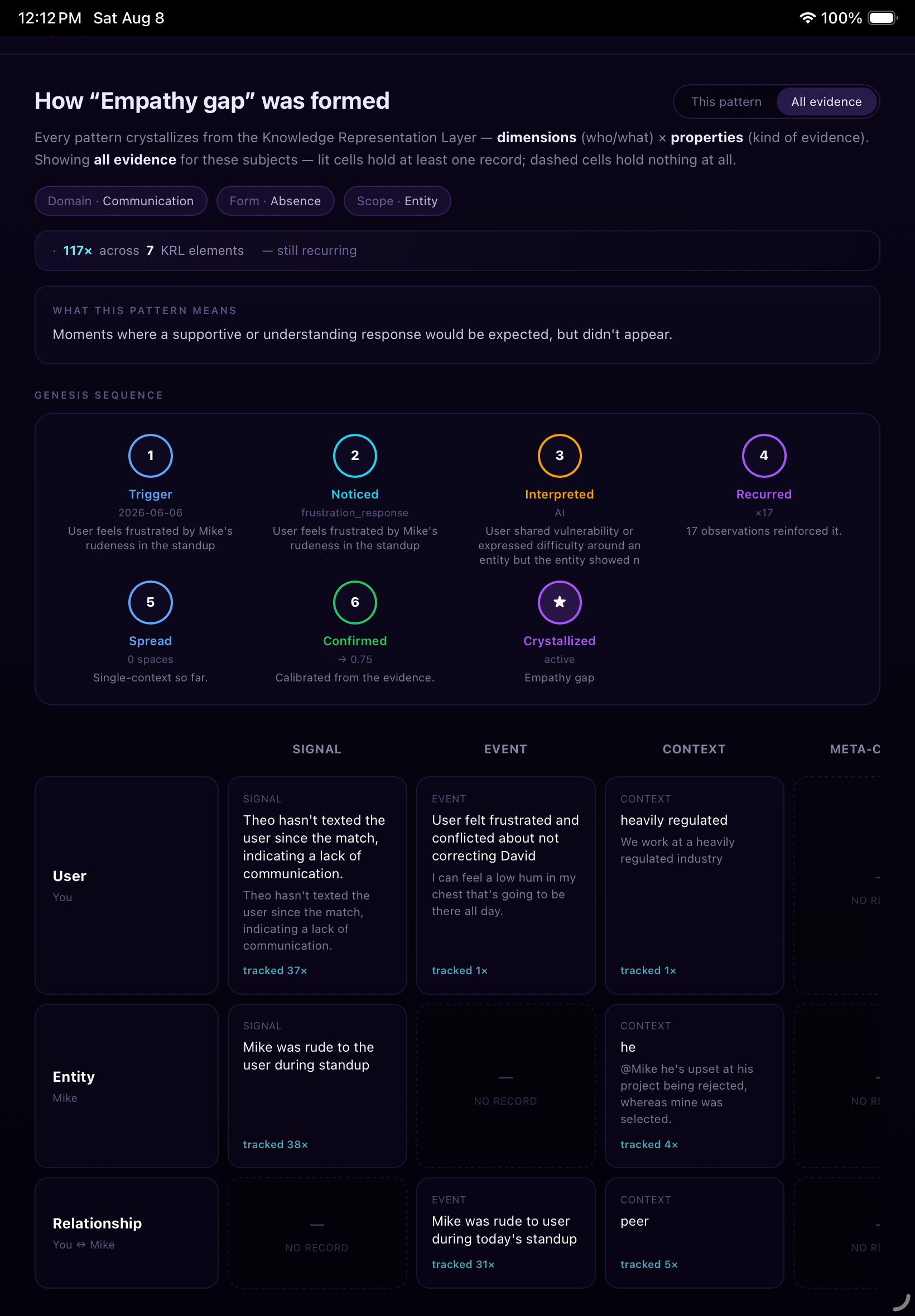
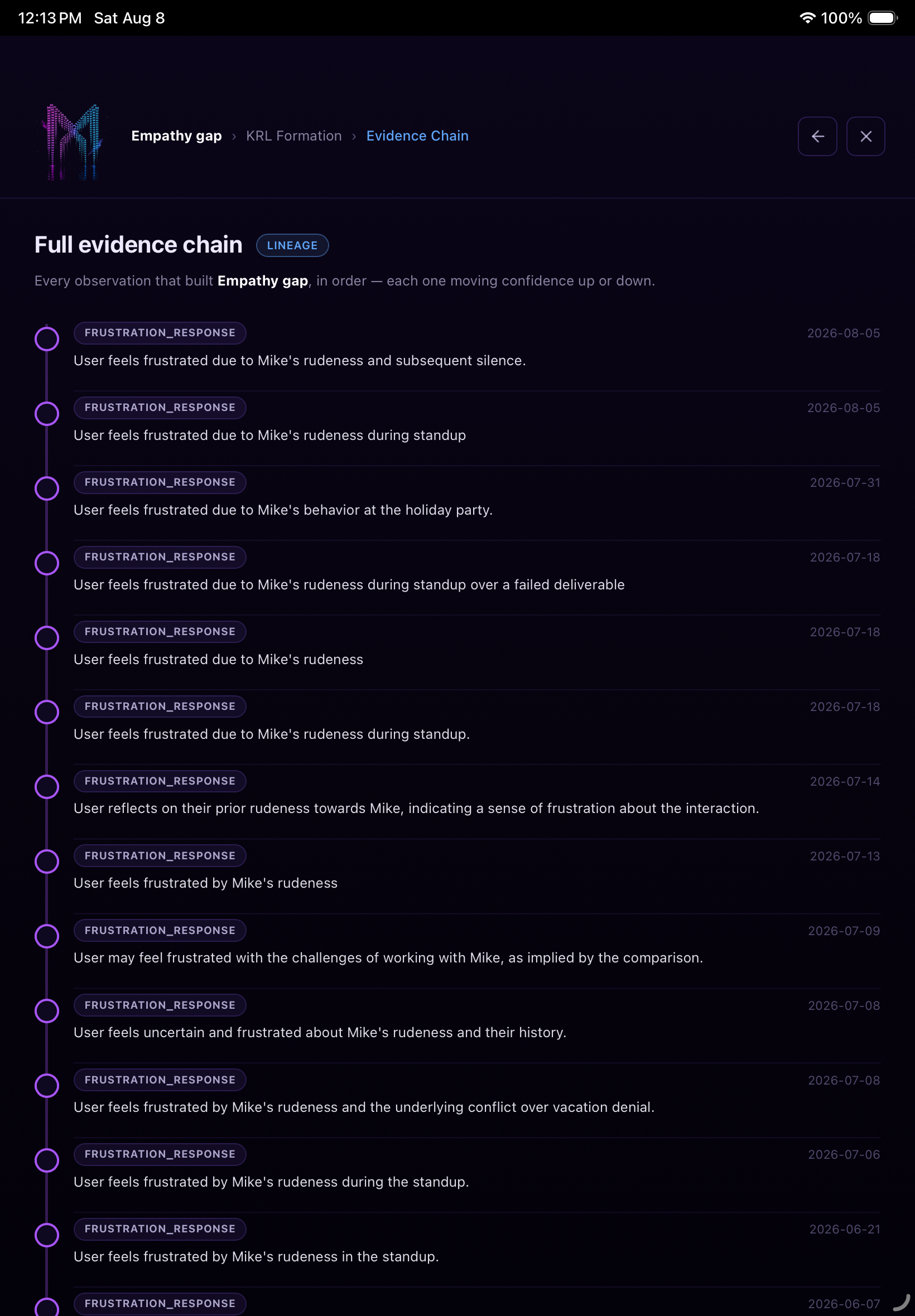
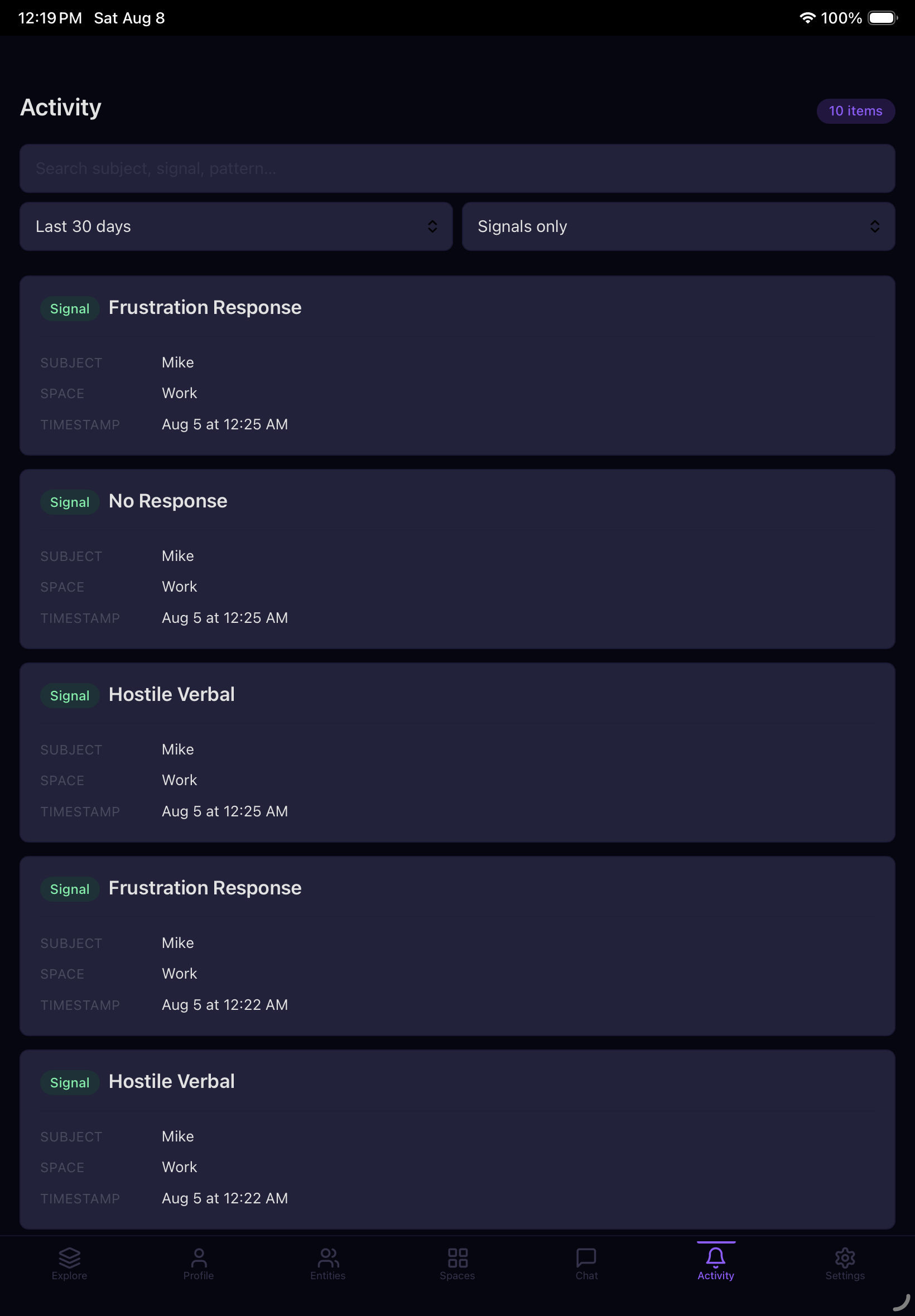
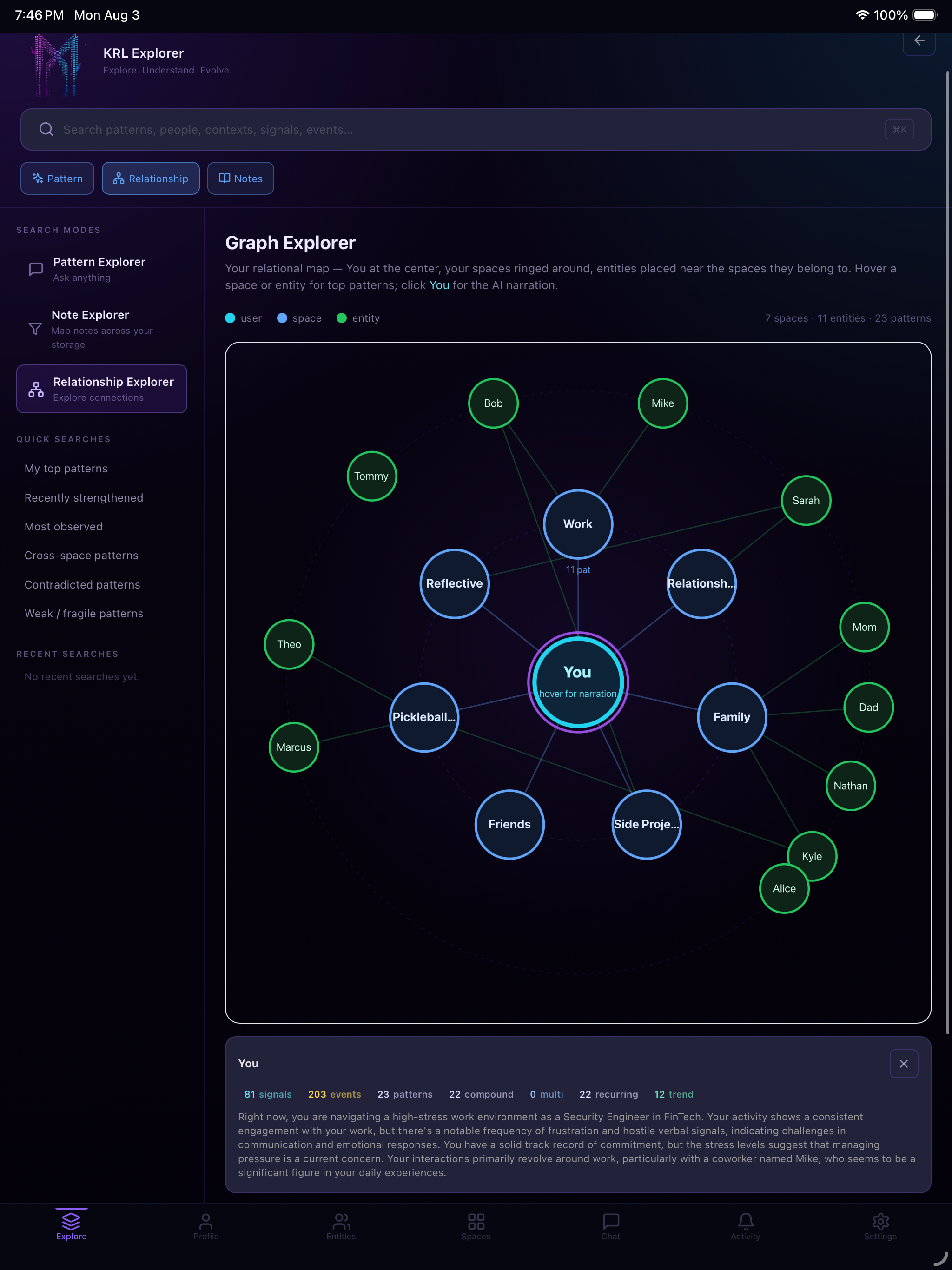
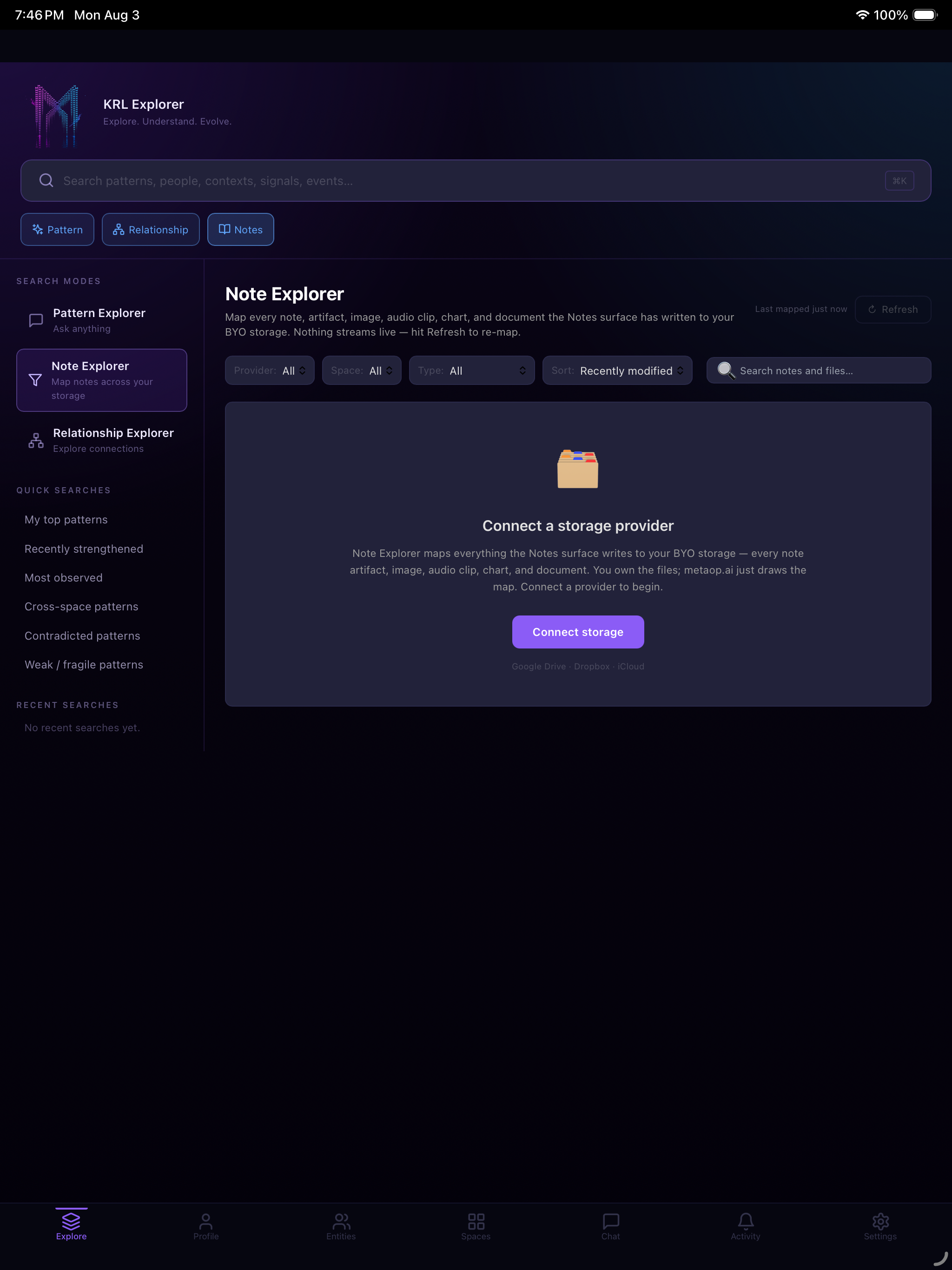
.xlsx. Token cost surfaced up-front so structured formats are a deliberate choice.The AI extracts signals from what you narrate. Over time, recurring signals form patterns. If a signal doesn't show up for a while, it decays — and any pattern it fed decays with it. The KRL Explorer lets you inspect that whole layer with provenance.
Bring Your Own Storage, Bring Your Own AI, Delete Means Delete, and the reasoning behind it all — laid out in full on the Security page.
Read Data & PrivacyThe hardest design constraint in this product is the one most other AI tools quietly violate. An AI that observes someone's interactions can legitimately surface what it sees. It cannot legitimately render judgment on people it has never met.
"Mike's response time has stretched in the last month. Previously same-day; now averaging two days. Cited from 7 journal entries between Apr 12 – May 8."
A grounded observation. Evidence is cited. The user can audit the trail. The interpretation is theirs to make.
"Your manager Mike is avoiding you. He probably has a problem with your performance or is being passive-aggressive about the promotion."
A verdict. Closes inquiry. Speculates on motive. No AI is qualified to render this kind of judgment about a third party.
Gradual decrease in responsiveness, warmth, or engagement over time — too gradual to notice in any single conversation.
Statements or behaviors that conflict with prior context, surfaced with both observations rather than silently overwritten.
Conflict followed by repair (or the absence of it). Cycles that repeat suggest something the user already knows but hasn't named.
Increasing distance, reduced openness, emotional fading — across multiple interaction surfaces with the same entity.
Stressors compounding across people and events within a space, not isolated to any one relationship.
Patterns that fired before, went quiet, and are firing again — framed differently than a first-time observation.
These are not features. They're commitments — the lines that don't move regardless of what's convenient to ship.
The system surfaces what it observes and shows its work. It does not diagnose people, predict motives, or render judgment on anyone in your life. You stay in the chair.
Every interpretation carries a confidence score. Recent observations weigh more than year-old ones. Patterns that go dormant decay; patterns that reactivate are surfaced with appropriate framing.
Every surfaced pattern cites its source signals. You can audit the trail. You can dismiss a pattern. The AI never insists — it offers, and the offering can always be questioned.
A shared safety module fires before any other reasoning across every chat surface. When the conversation moves into high-stakes territory, the AI bridges you to a human resource — it does not try to be the resource.
The goal is clarity outside the system — better-handled conversations in your actual life. Not engagement inside an app. We measure success by how capable you feel out there, not by how often you come back.
Every narration, every signal, every pattern is encrypted. We hold the data you generate to the same standard you hold your private thoughts.
For over a decade, I've worked in security and cloud infrastructure across global financial institutions, helping design and secure systems that support critical platforms and emerging technologies. Over the last few years, that work increasingly shifted toward AI — evaluating enterprise tools, securing deployments, and understanding how context, orchestration, and human behavior shape AI systems in practice.
MetaOpAI emerged from a simple observation: most AI systems treat interactions as isolated moments. People don't operate that way. Relationships, decisions, patterns, and behavior are built over time through accumulated context. MetaOpAI is an exploration of what happens when AI is designed to retain signal across those moments rather than continuously resetting the conversation.
This project remains intentionally small and hands-on. The architecture, safety systems, infrastructure, and underlying design are built with the same principles used in security engineering: deliberate decisions, observable systems, and a bias toward long-term reliability over short-term complexity.
The belief behind MetaOpAI is straightforward: context compounds. Small signals become patterns, patterns become understanding, and understanding creates clarity.
MetaopAI runs on a daily token allowance that resets every morning. Free tier gives you 100,000 tokens a day — enough to journal and track a handful of relationships. Paid plans expand your workspace and daily capacity. Need more headroom in the moment? Burst packs top you up instantly, no subscription required.
Start free. Pay when you need more.
Free tier — always available
100,000 tokens / day · 1 space · 2 entities · Resets 6:00 AM your local time
Light personal use — a handful of relationships.
Most-used tier — solid coverage across your network.
Power users — full daily capacity, larger workspace.
One-time top-ups. 4-hour window. Subscribers pay half.
About burst packs
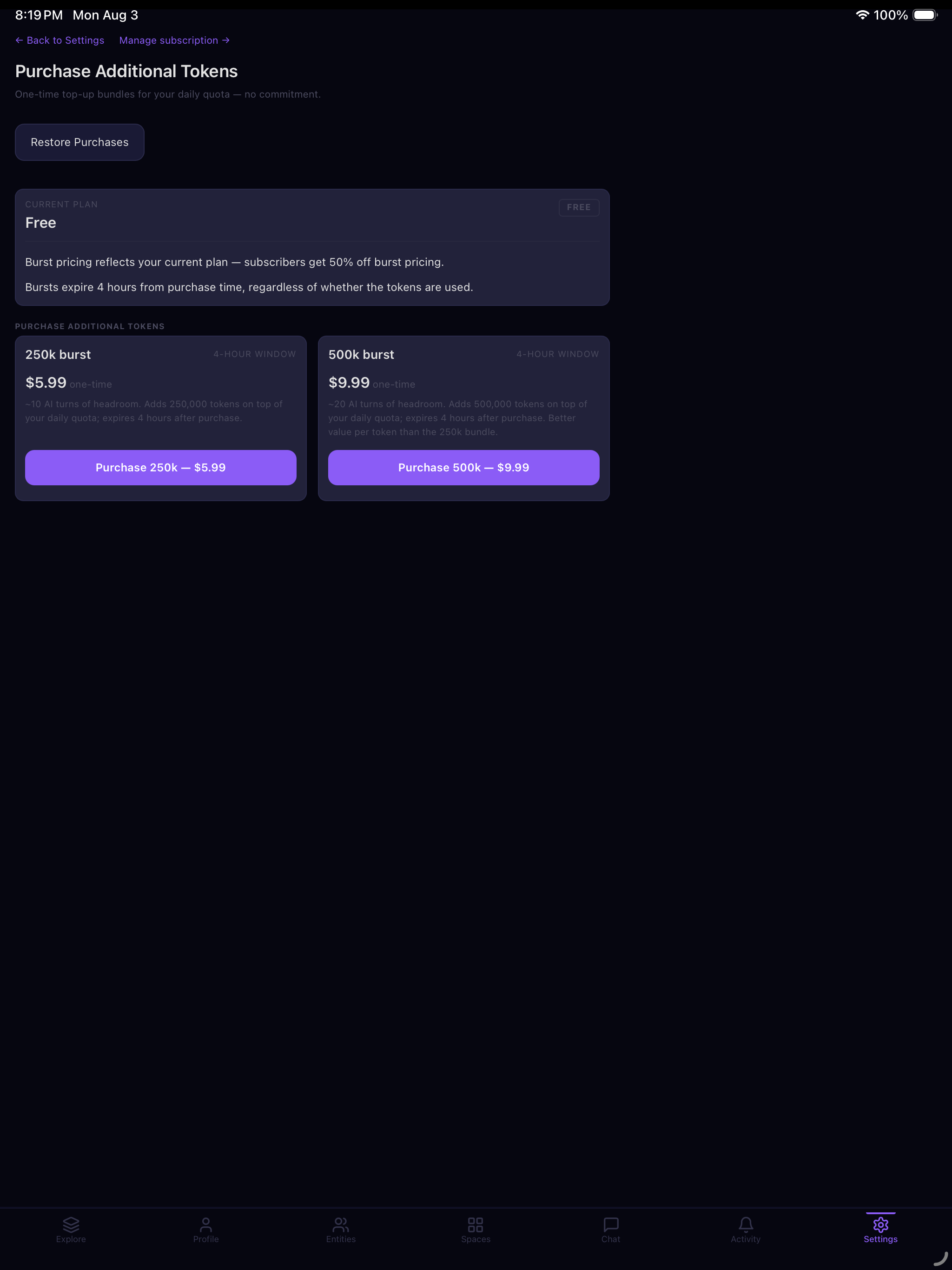
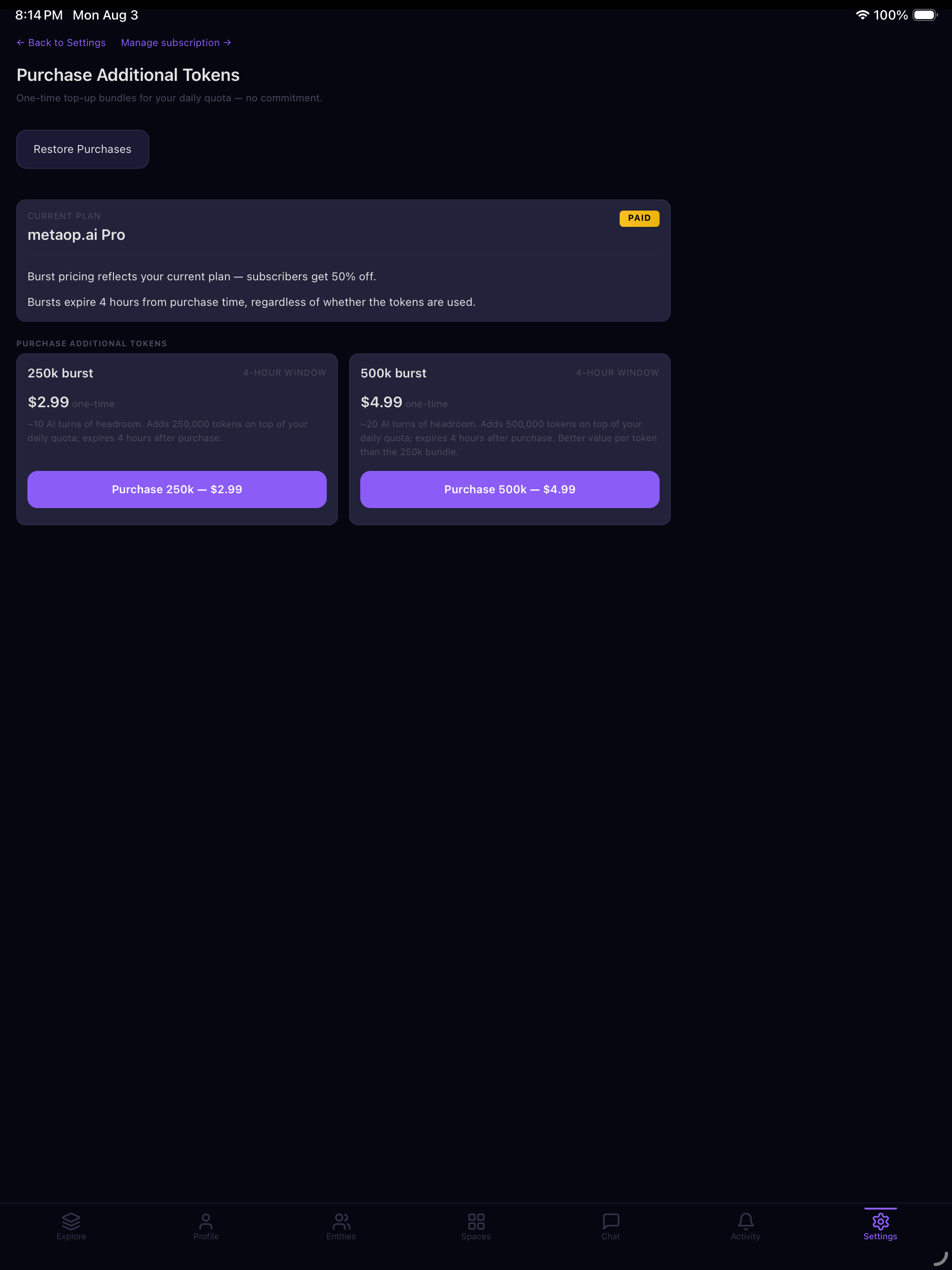
Burst packs are one-time token top-ups that sit on top of your daily quota — no subscription required. Each pack expires 4 hours after purchase, whether used or not. Free users pay full price ($5.99 / $9.99). Any paid subscriber pays half ($2.99 / $4.99).
Every account tracks its own tokens, resets, and history — always visible.
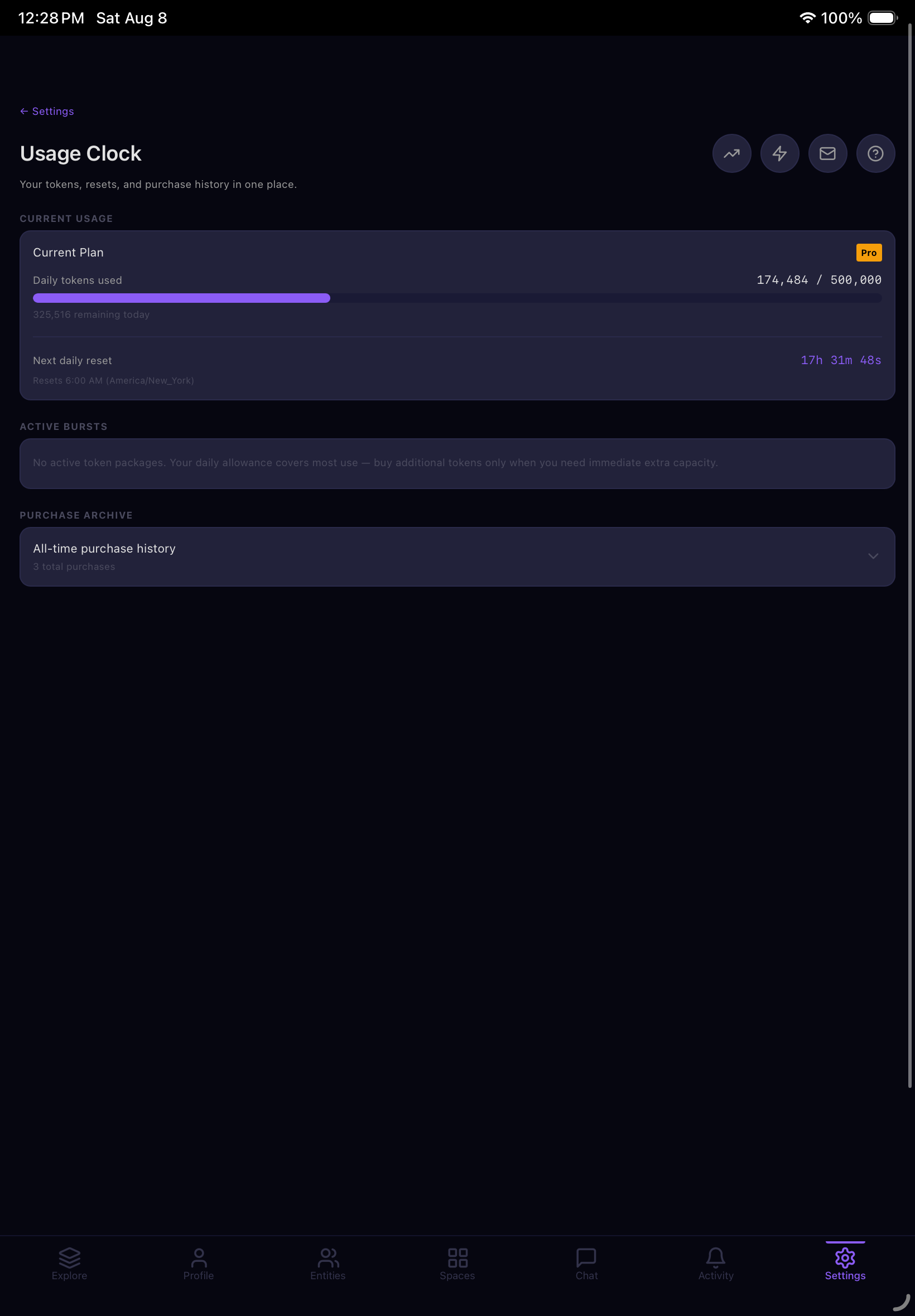
Every account gets a Usage Clock. It shows exactly what you're spending, when the next reset happens, and which burst packs are still active — so pricing never feels like a mystery.
MetaopAI is a probabilistic interpersonal cognition system. It extracts signals, events, and emotional atmosphere from what you write, structures them in a typed Knowledge Representation Layer, models the relationships and spaces in your life as evolving state, and compounds recurring observations into longitudinal patterns — with confidence scoring, contradiction handling, and temporal decay built in.
Not an oracle that claims to know the truth. A contextual interpretation engine that gets sharper the longer you write.
Confidence over certainty.
Interpretation over diagnosis.
Patterns, not verdicts.