AI Signal Intelligence · Private Beta

Be understood.
Operate with clarity.

A private intelligence that listens, remembers, and compounds context across the relationships in your life — and surfaces the patterns no one else can see. Not advice. Not verdicts. Just clearer signal.

Private beta · Invite only
Coming soon App Store
Coming soon Google Play
01 — The problem
A familiar moment

You've been here.
Trying to make sense of someone.

A friend who's pulling away. A manager whose tone shifted last month. A partner whose evenings feel a little different lately. You sense something — but you can't quite name it. So you reach out for help.

Today, you have four choices. None of them are built for this.

Option 01 — A partner or spouse

They love you. They're missing the backstory.

The gap · Context tax & well-meaning noise

You start narrating from the beginning — the personalities, the history, the baseline, the deviation from baseline, finally the event itself. By the time you reach the question, half an hour is gone. Their feedback is loving and well-meaning, but it's downstream of a story you had to rebuild from scratch. You walk away supported. Not clearer.

Option 02 — A friend

They have an opinion. Or you can't tell them at all.

The gap · Bias, exposure, confidentiality

Your friend has their own emotional stake — opinions form, sides get taken, things get repeated. And some situations are simply too sensitive, professional, or close to home to confide in anyone in your circle in the first place.

Option 03 — A therapist

Once a week. About you.

The gap · Cost & coverage

$150–$300 a session. Once a week if you're lucky. Therapy is built to help you understand your internal experience — not to keep structured memory of every person in your life and the patterns between them.

Option 04 — An AI chatbot

Smart. Willing. Amnesiac.

The gap · No memory, no patterns

You open ChatGPT or Claude, narrate the whole situation, and get something insightful. Then tomorrow, blank slate. The next event gets analyzed without yesterday's context. Patterns can't compound if memory can't persist.

The gap

The thing you actually want is something that holds your story — that listens carefully, remembers precisely, and tells you what it sees over time. Without bias. Without verdicts. Without forgetting.

02 — The approach
An open experiment
// hypothesis The bottleneck in AI utility for personal reasoning isn't model capability — it's structured, persistent context.

// method Build a typed, multi-dimensional memory layer (the KRL) and let interpretation emerge from compounded signal over time.

// posture Patterns, not verdicts.
Probabilistic, not absolute.
Evolving, not static.

Everyone is scaling models.
We're investigating context.

The dominant conversation in AI is about bigger models, better reasoning, longer context windows. All of that matters. But for the kind of dialogue a person actually needs — substantive, accumulating, personally relevant — there's a different question worth asking.

What if the missing layer isn't the model itself, but the way context is structured around it? What if "memory" alone isn't enough — what's needed is a typed, multi-dimensional state that grows in fidelity, decays appropriately, surfaces contradictions, and compounds raw observation into emergent pattern?

MetaopAI is an experiment in that direction. We're not claiming to have solved anything. We're modeling context the way an attentive observer would — and seeing how far that takes us toward AI dialogue that is both more precise and more honest about what it cannot know.

The compounding bet

Raw signals are cheap.
Structured signals over time are not.

03 — Flow
How it works

From conversation to clarity,
in four moves.

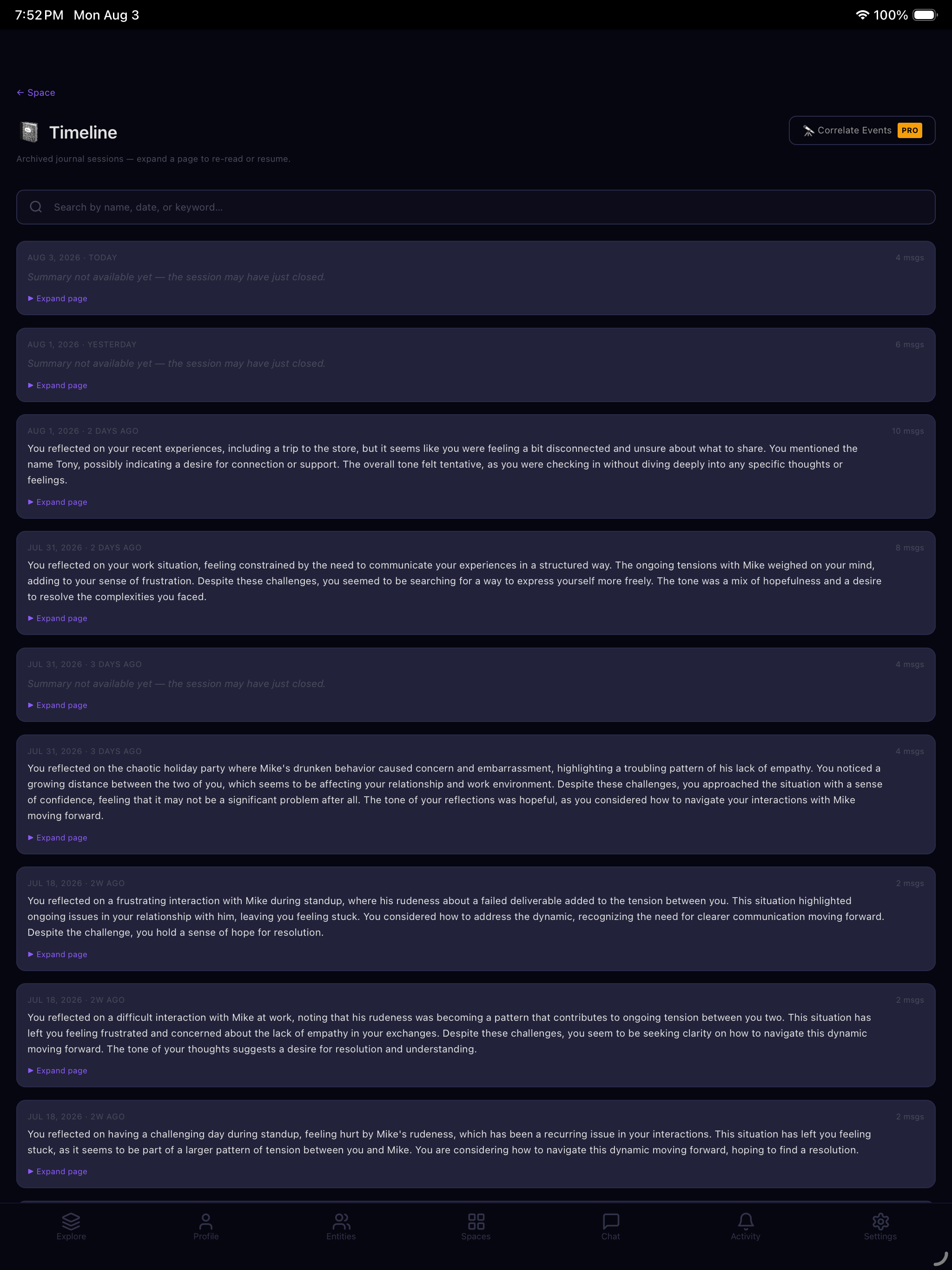
The product side is simple. You narrate. The system extracts. Patterns surface. You see yourself and the people around you more clearly than you did yesterday.

01 · Input

Narrate naturally

Write the way you'd talk to a confidant. No prompts to learn, no structure to follow. Tell the story as it happened.

02 · Extract

Signals surfaced

Five parallel extractors identify who, what, where, when, and how — typed observations land in a structured graph.

03 · Compound

Patterns emerge

Signals reinforce, contradict, decay. Compounded across days and weeks, dynamics become visible that no single conversation could have shown.

04 · Insight

Clarity returned

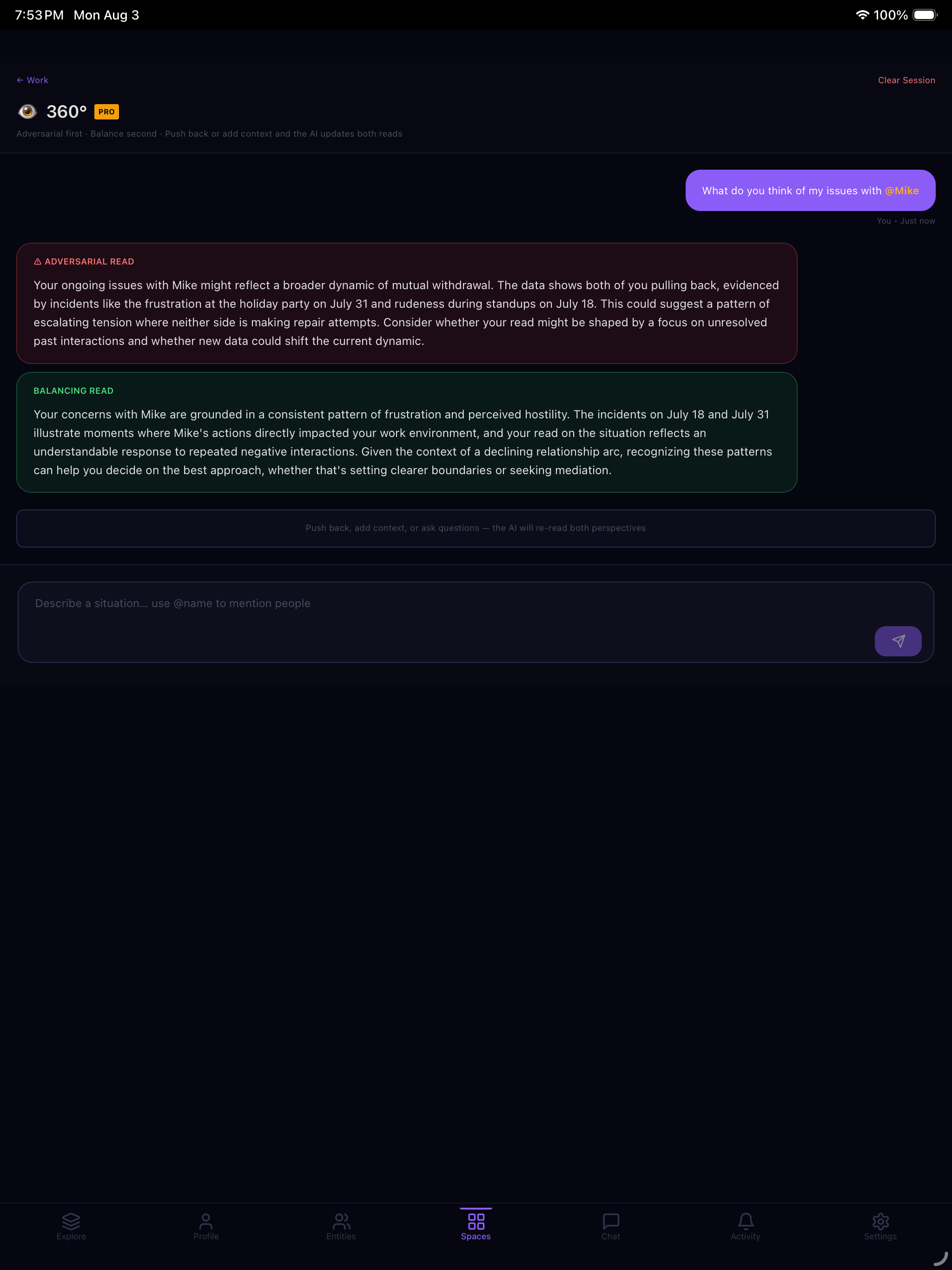
Patterns named. Sources cited. Alternative readings offered. You stay in the chair — the system shows its work, never renders a verdict.

04 — Architecture
The Knowledge Relational Layer

Context isn't a window.
It's a state that compounds.

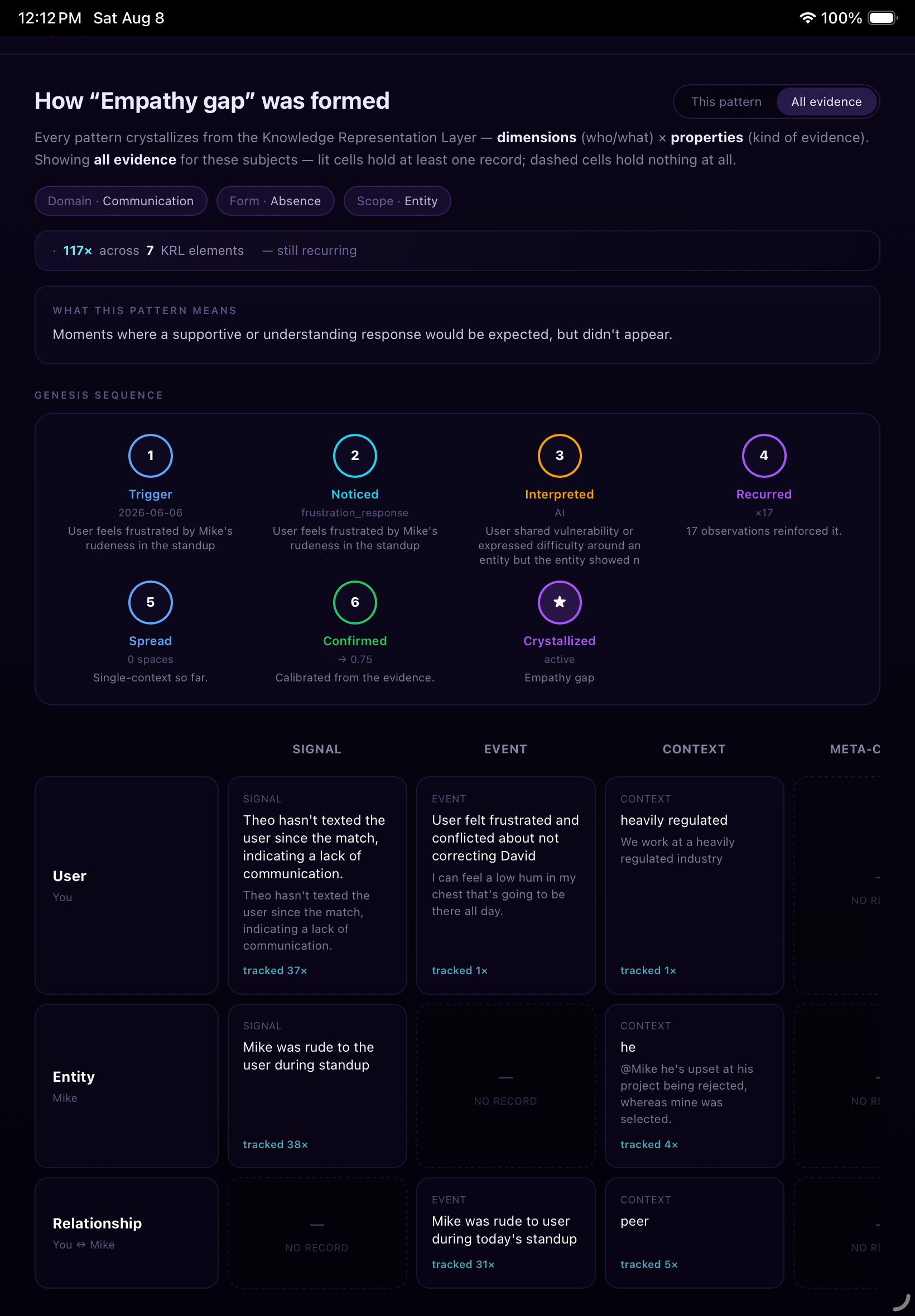
Under the hood, MetaopAI is built on a typed, multi-dimensional knowledge graph called the KRL. Every observation lands in a specific cell — by subject (the user, an entity, a space, or a relationship pair) and by layer (signal, event, meta-context, context, or pattern).

Stable layers are queried first. Volatile layers update on every turn. Patterns are not extracted — they're computed across the lower layers, with confidence scores, time-decay, and contradiction detection built in.

MetaopAI Residual Contextual Pipeline — from raw journal input through signal/event/meta-context/context/pattern extraction, to pattern engine, context engine, LLM reasoning, and insight output. Includes the residual contextual state showing how signals compound over time T1 → T2 → T3, like ingredients in a blender.
Fig. 01 — The Residual Contextual Pipeline. Raw narrative → typed extraction → KRL state → pattern compounding → reasoning interface → insight.
Layer 01

Signals

Volatile

Small behavioral observations. Raw, granular, highly volatile. The texture of moment-to-moment interaction.

Layer 02

Events

Anchored

Discrete happenings with timestamps. The argument on Tuesday. The promotion in March. Anchors in time.

Layer 03

Context

Most stable

Profile facts & identity. Who someone is, what role they play, the stable scaffolding of a relationship.

Layer 04

Meta-Context

Slow-moving

Subjective atmosphere — how a space feels. Emotional environment and interpretive backdrop.

Layer 05

Patterns

Emergent

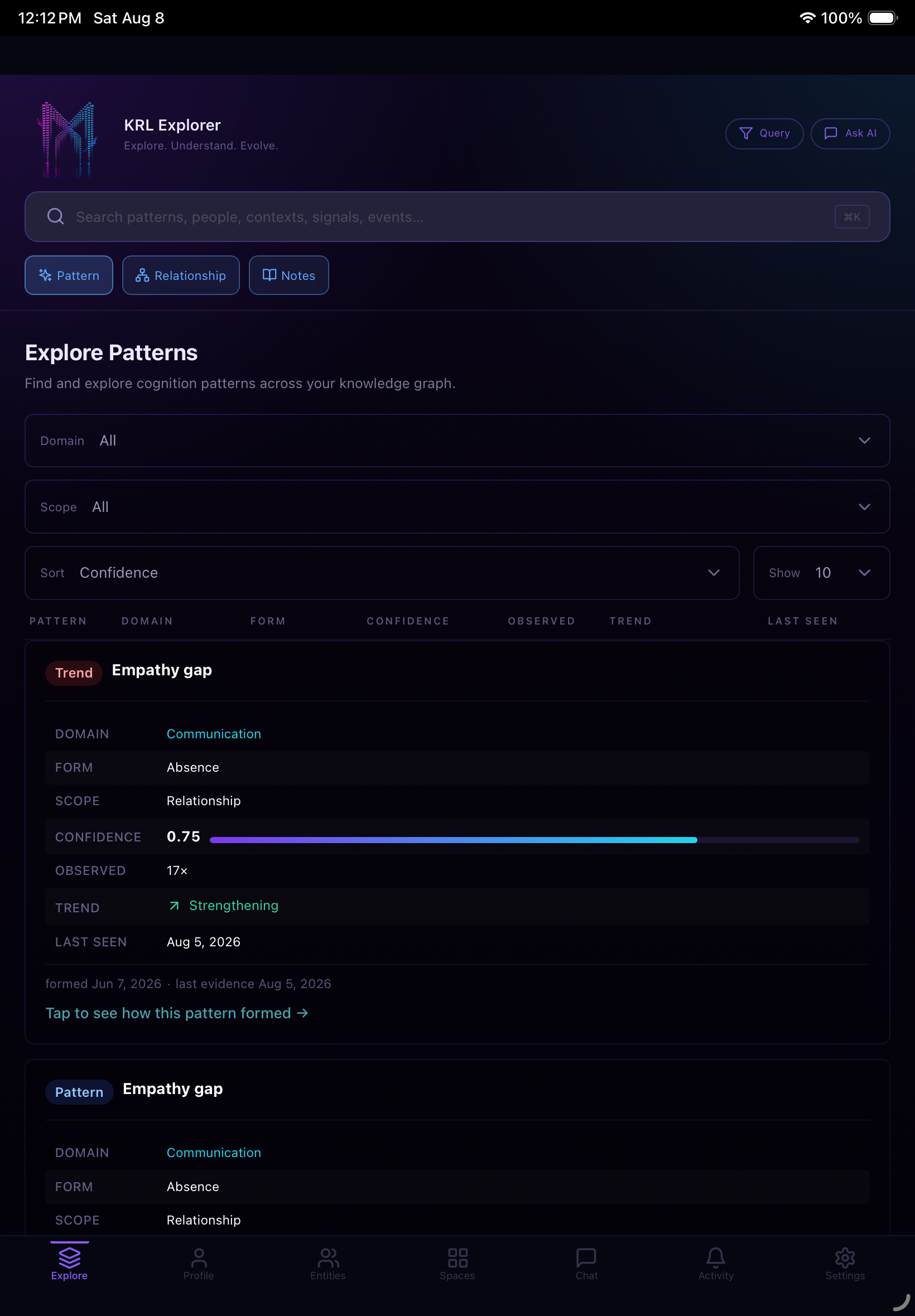
Longitudinal interpretations. Computed, not extracted. Reinforced, decayed, reactivated as the lower layers evolve.

05 — Pattern engine
The ethical commitment

Patterns, not verdicts.

The hardest design constraint in this product is the one most other AI tools quietly violate. An AI that observes someone's interactions can legitimately surface what it sees. It cannot legitimately render judgment on people it has never met.

What MetaopAI will say

"Mike's response time has stretched in the last month. Previously same-day; now averaging two days. Cited from 7 journal entries between Apr 12 – May 8."

A grounded observation. Evidence is cited. The user can audit the trail. The interpretation is theirs to make.

What MetaopAI will not say

"Your manager Mike is avoiding you. He probably has a problem with your performance or is being passive-aggressive about the promotion."

A verdict. Closes inquiry. Speculates on motive. No AI is qualified to render this kind of judgment about a third party.

Pattern outputs

A few examples of what the engine surfaces.

Communication drift

Slow erosion of warmth

Gradual decrease in responsiveness, warmth, or engagement over time — too gradual to notice in any single conversation.

Trust instability

Contradictions accumulating

Statements or behaviors that conflict with prior context, surfaced with both observations rather than silently overwritten.

Conflict–repair cycle

Recurrence without resolution

Conflict followed by repair (or the absence of it). Cycles that repeat suggest something the user already knows but hasn't named.

Emotional withdrawal

Distance becoming default

Increasing distance, reduced openness, emotional fading — across multiple interaction surfaces with the same entity.

Workplace tension

Environmental stress

Stressors compounding across people and events within a space, not isolated to any one relationship.

Dormant reactivation

A pattern that came back

Patterns that fired before, went quiet, and are firing again — framed differently than a first-time observation.

06 — Inside the app
Inside the app

Three primitives.
Ten ways to ask a question.

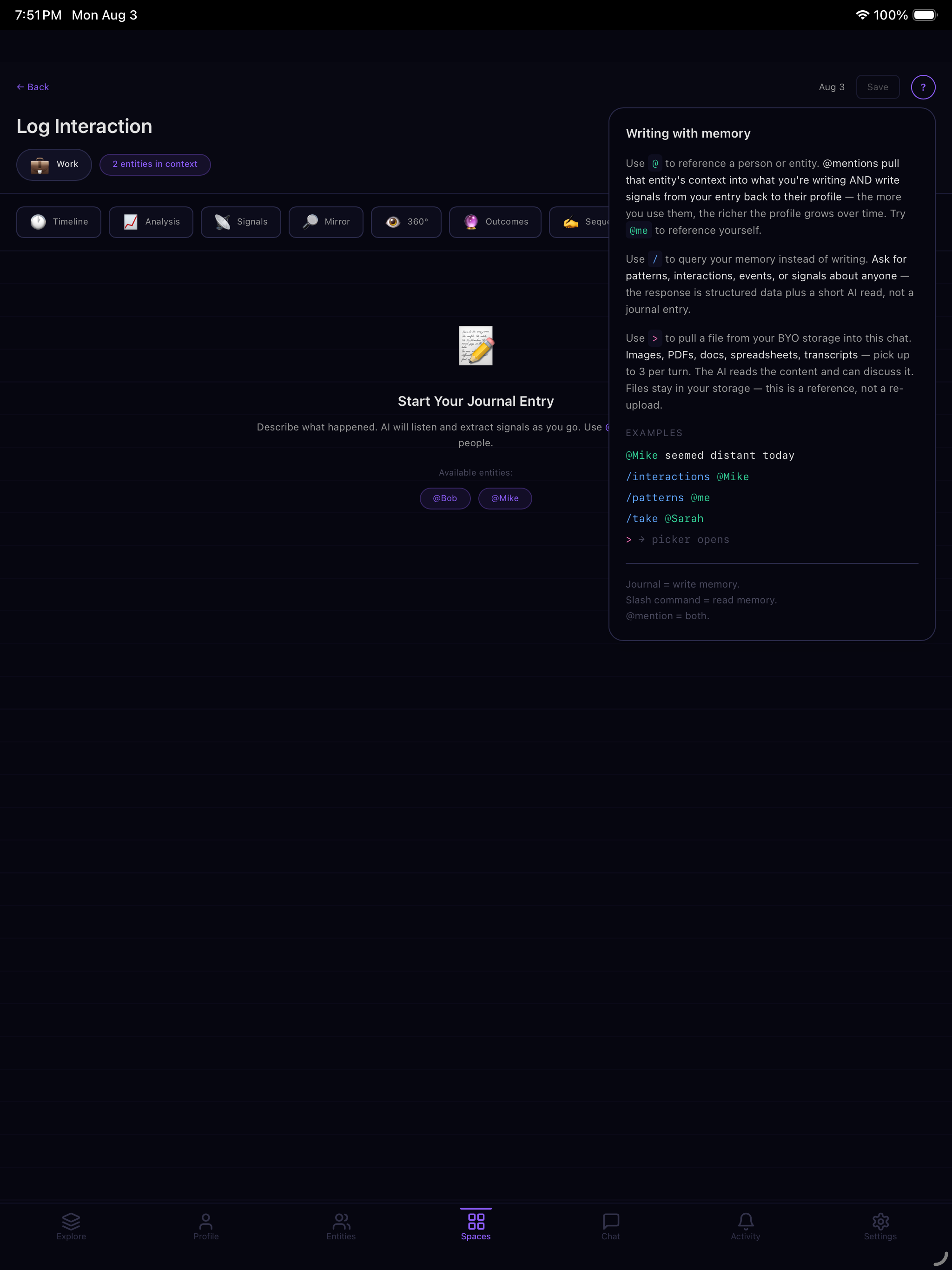
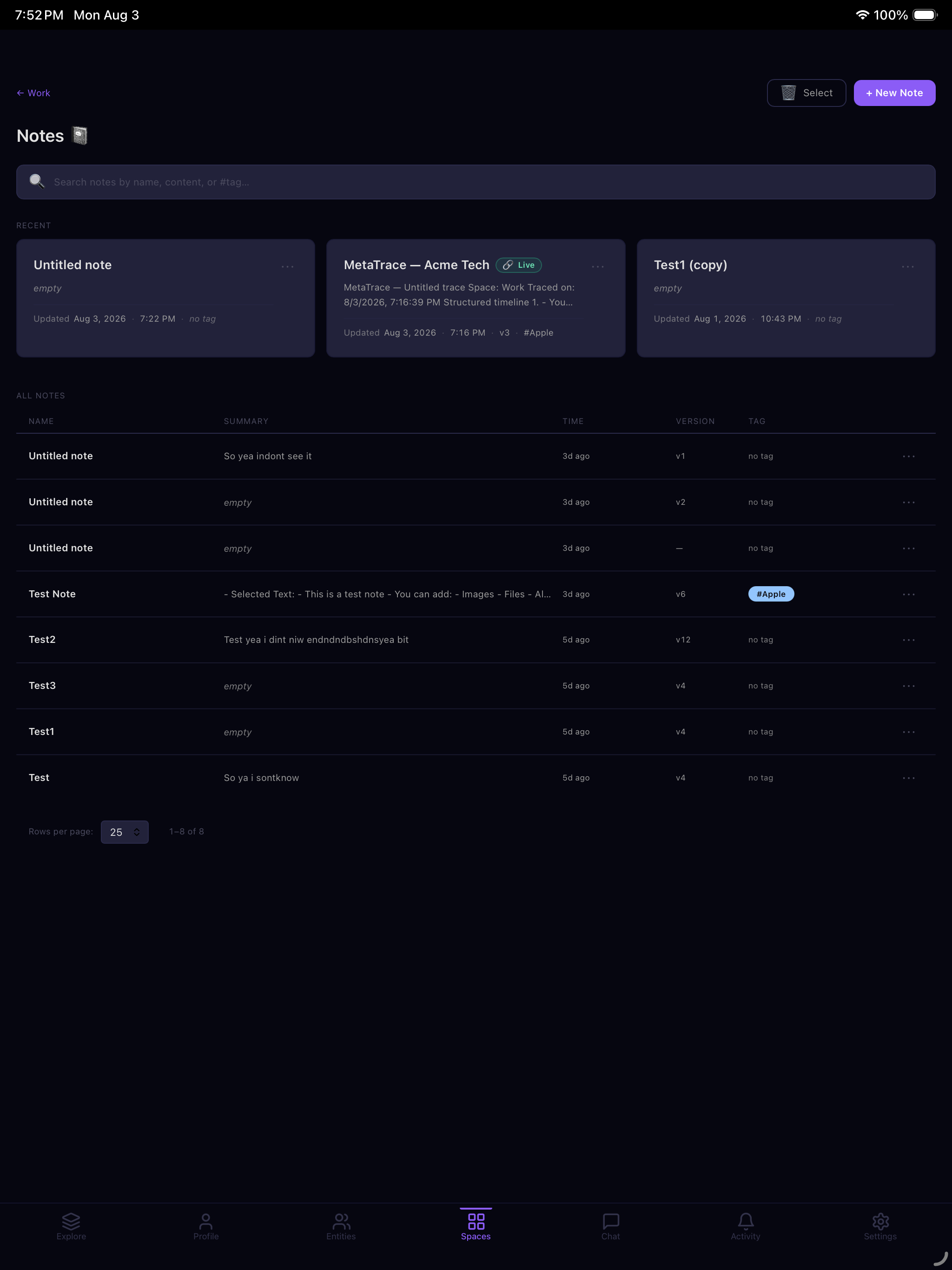
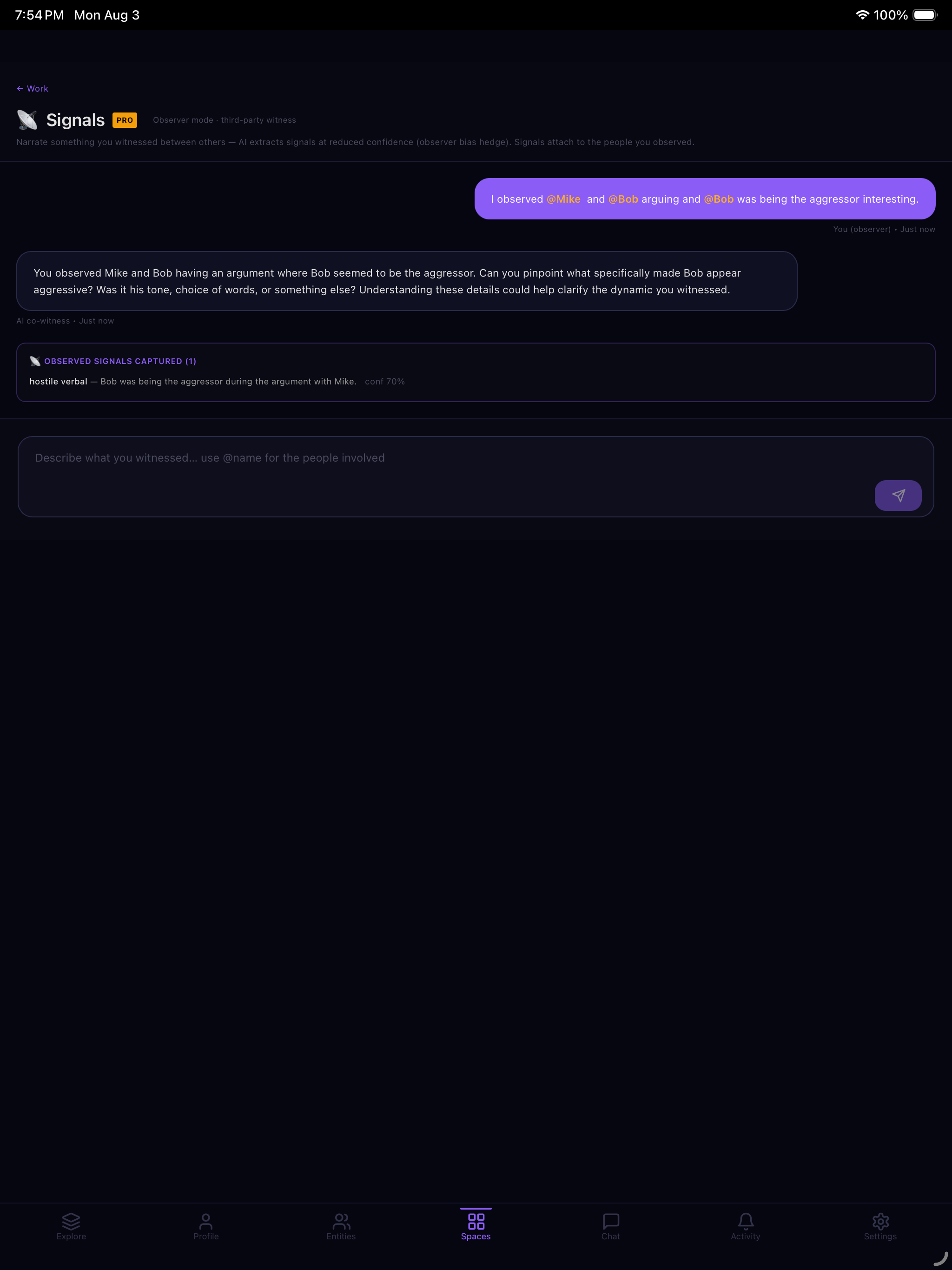
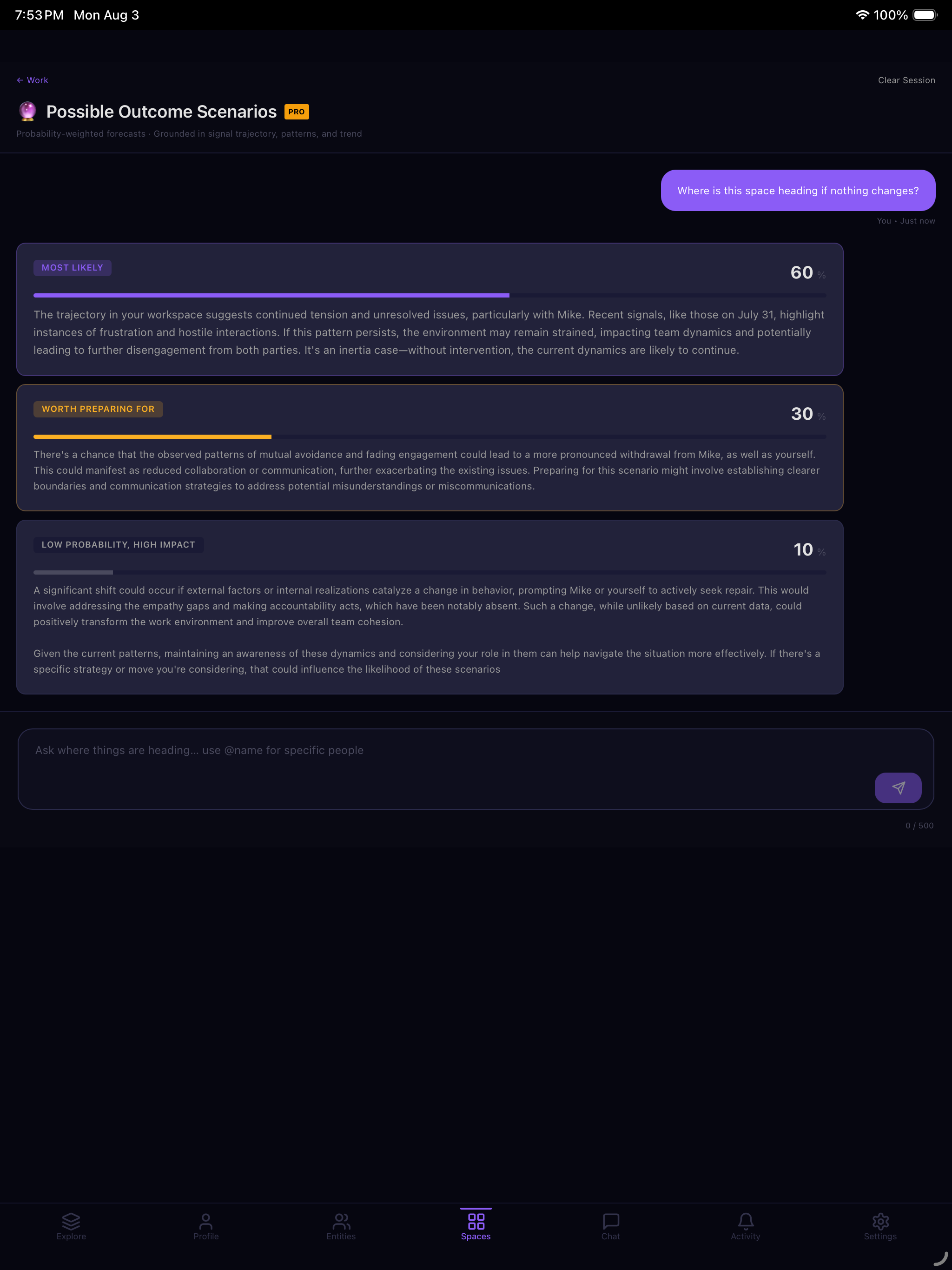
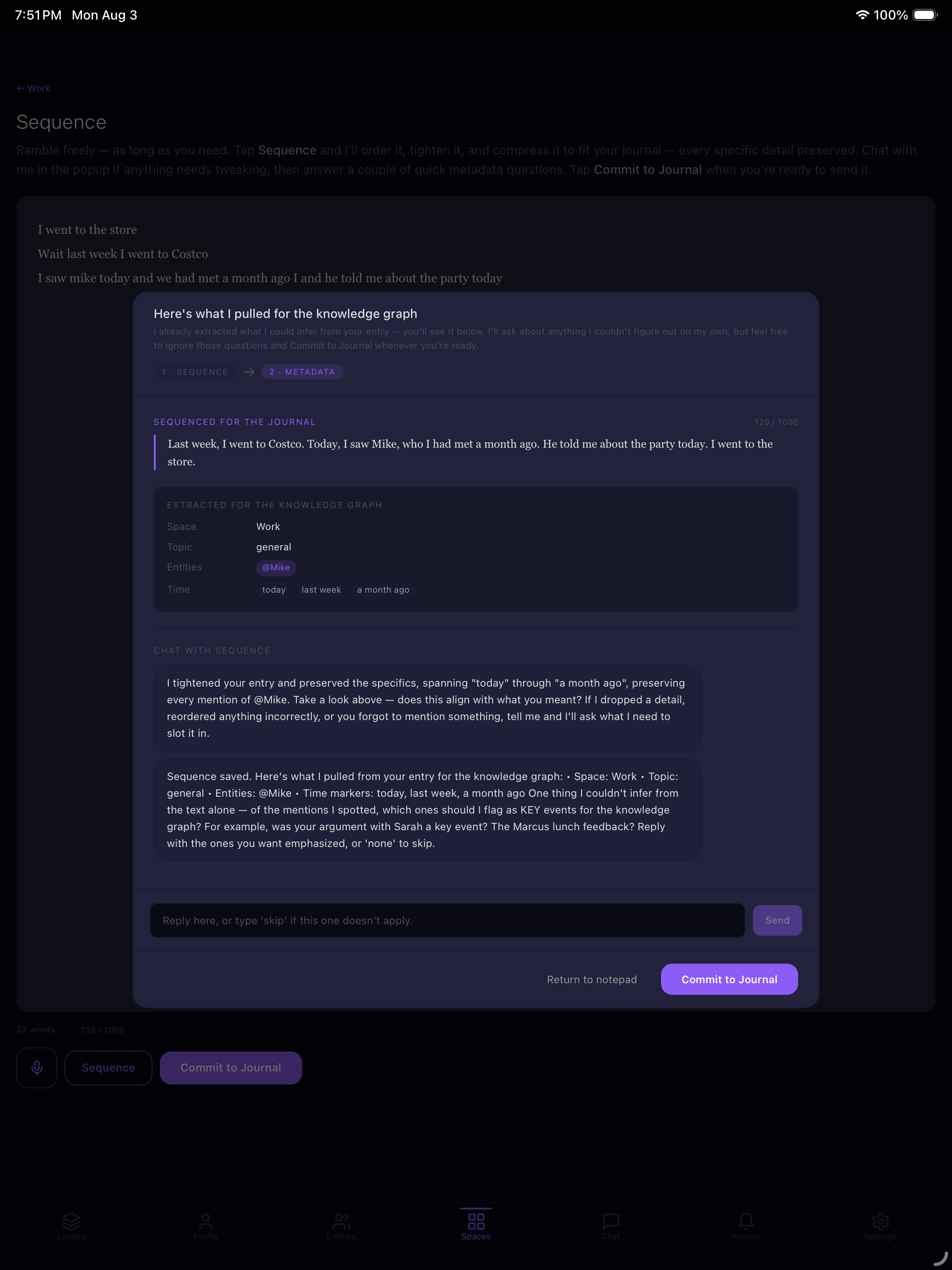
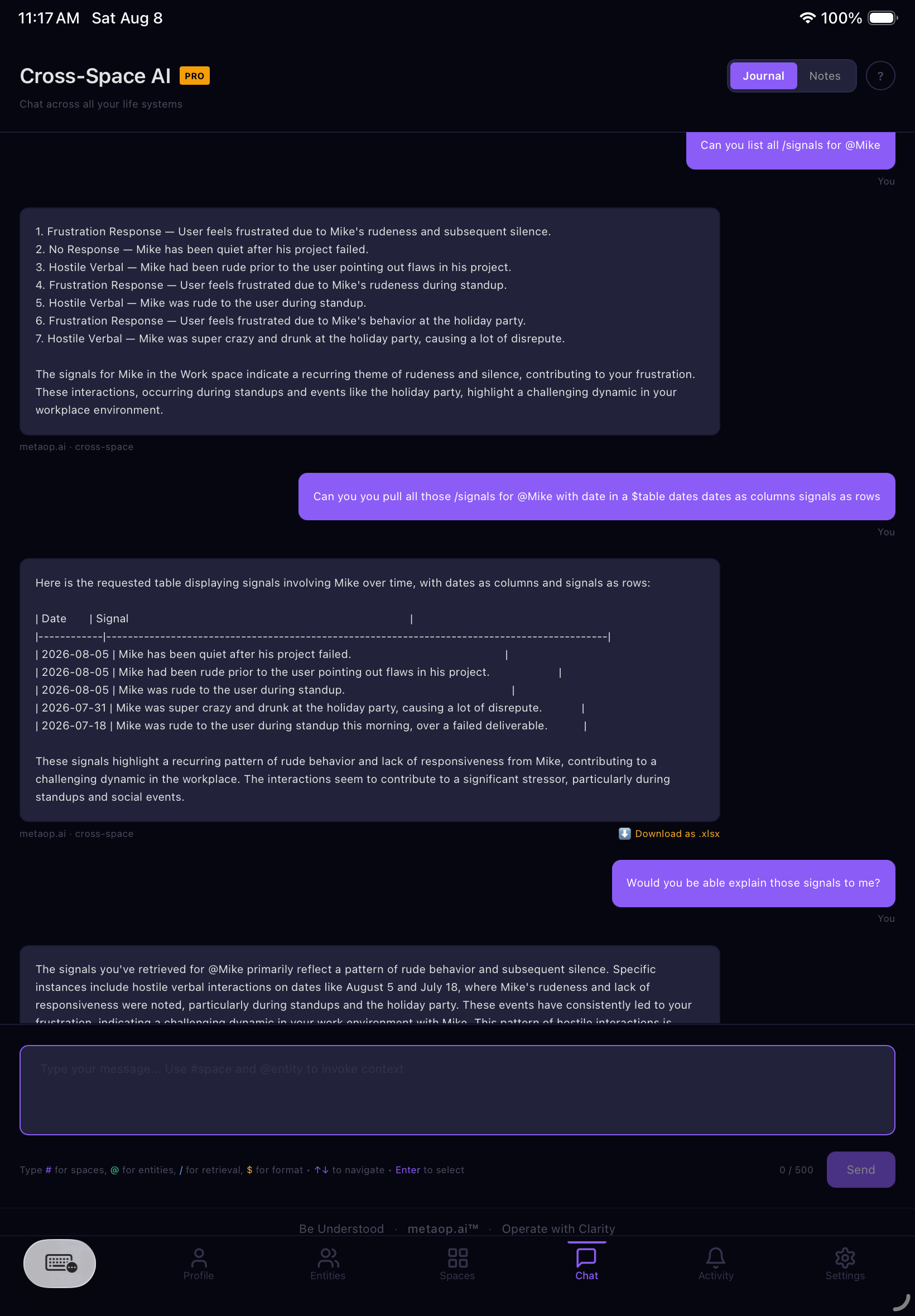
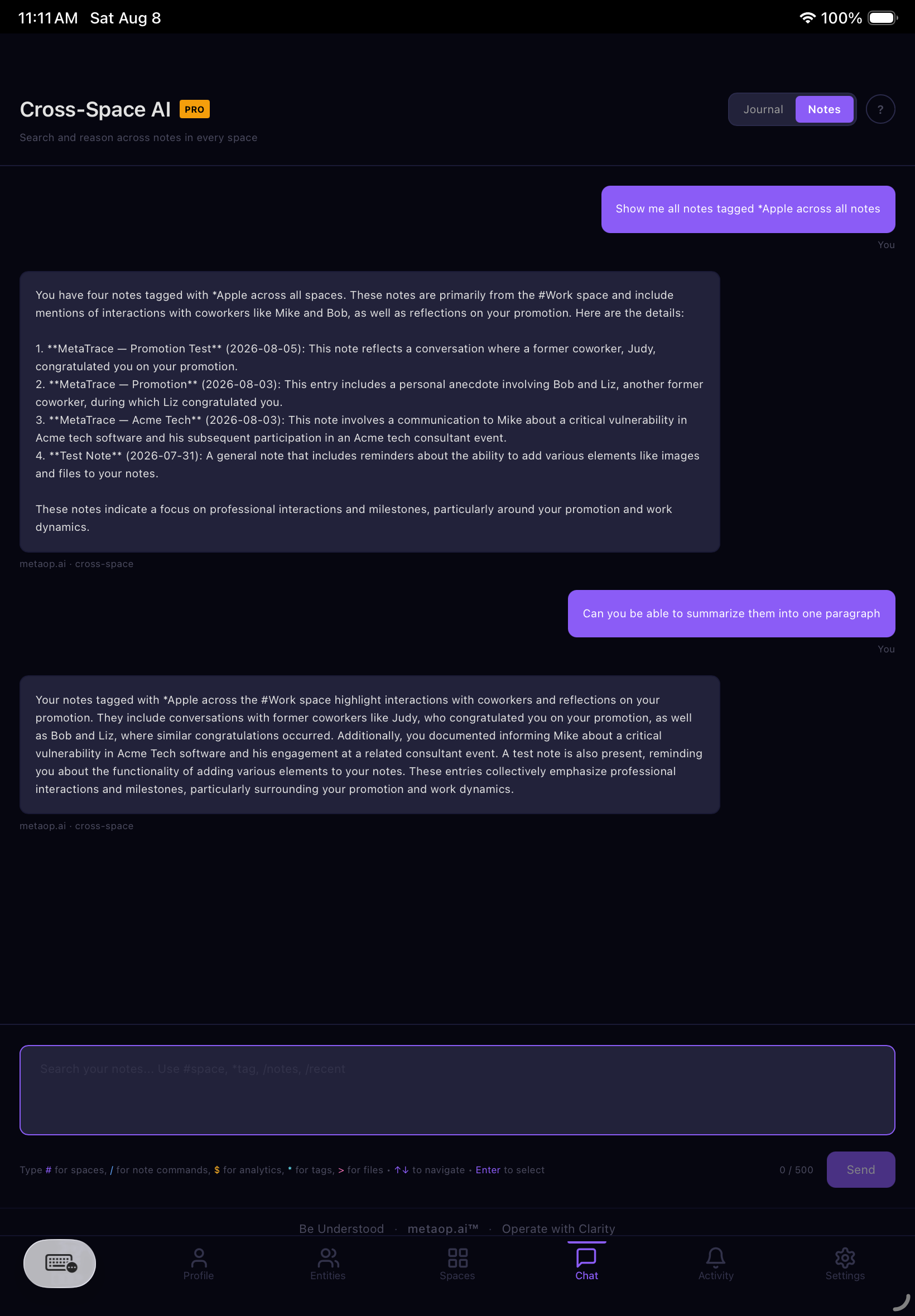
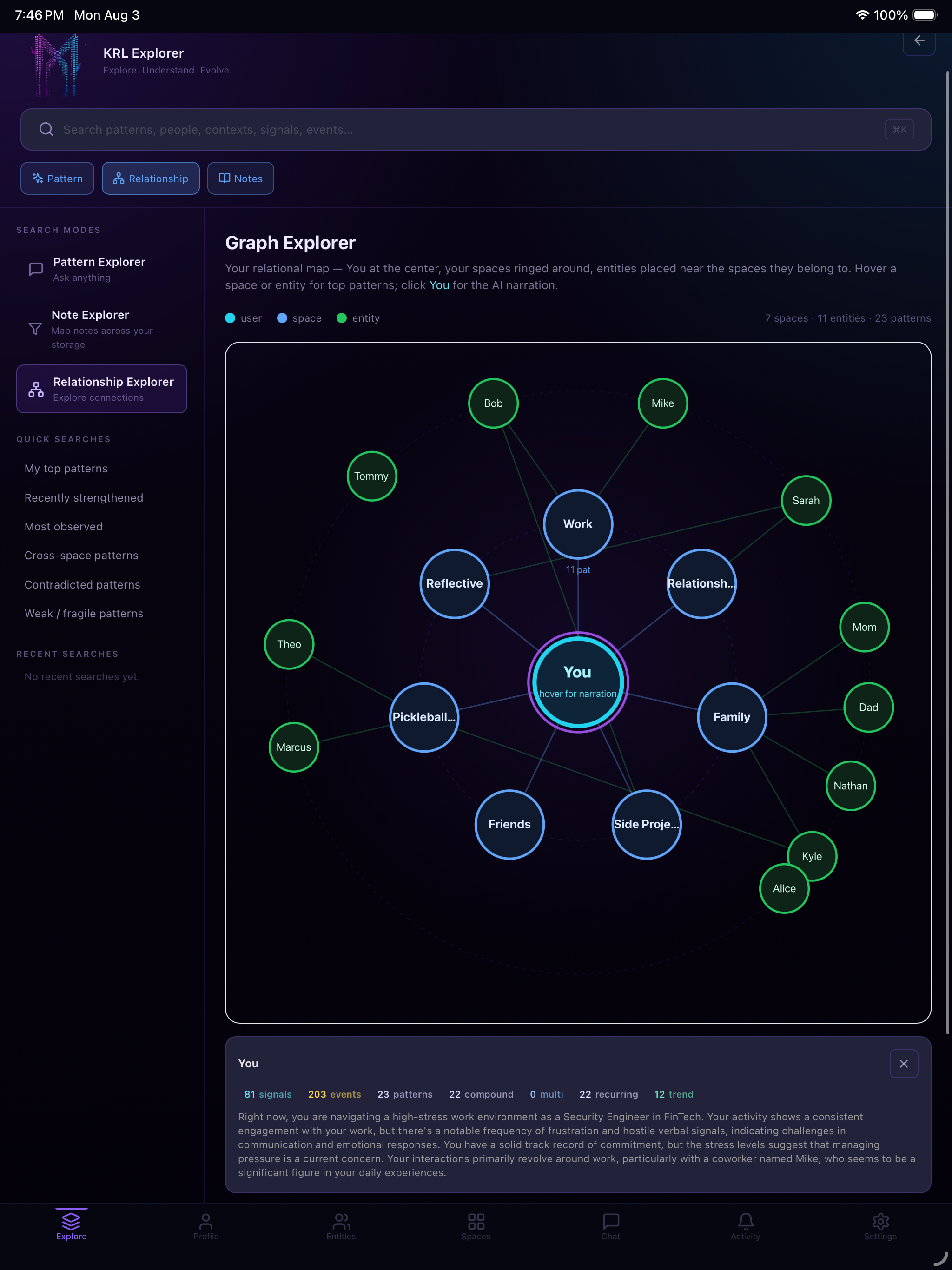
Spaces organize life. Entities model the people in it. Your profile is the longitudinal portrait of you. Ten distinct chat surfaces — Journal, Mirror, View 360, Predictive, Cross-Space, Entity Narration, Space Analysis, Score Explained, Burst, Observer Signals — query the same underlying context in different voices.

Primitive 01 · Spaces

Organize life into spaces.

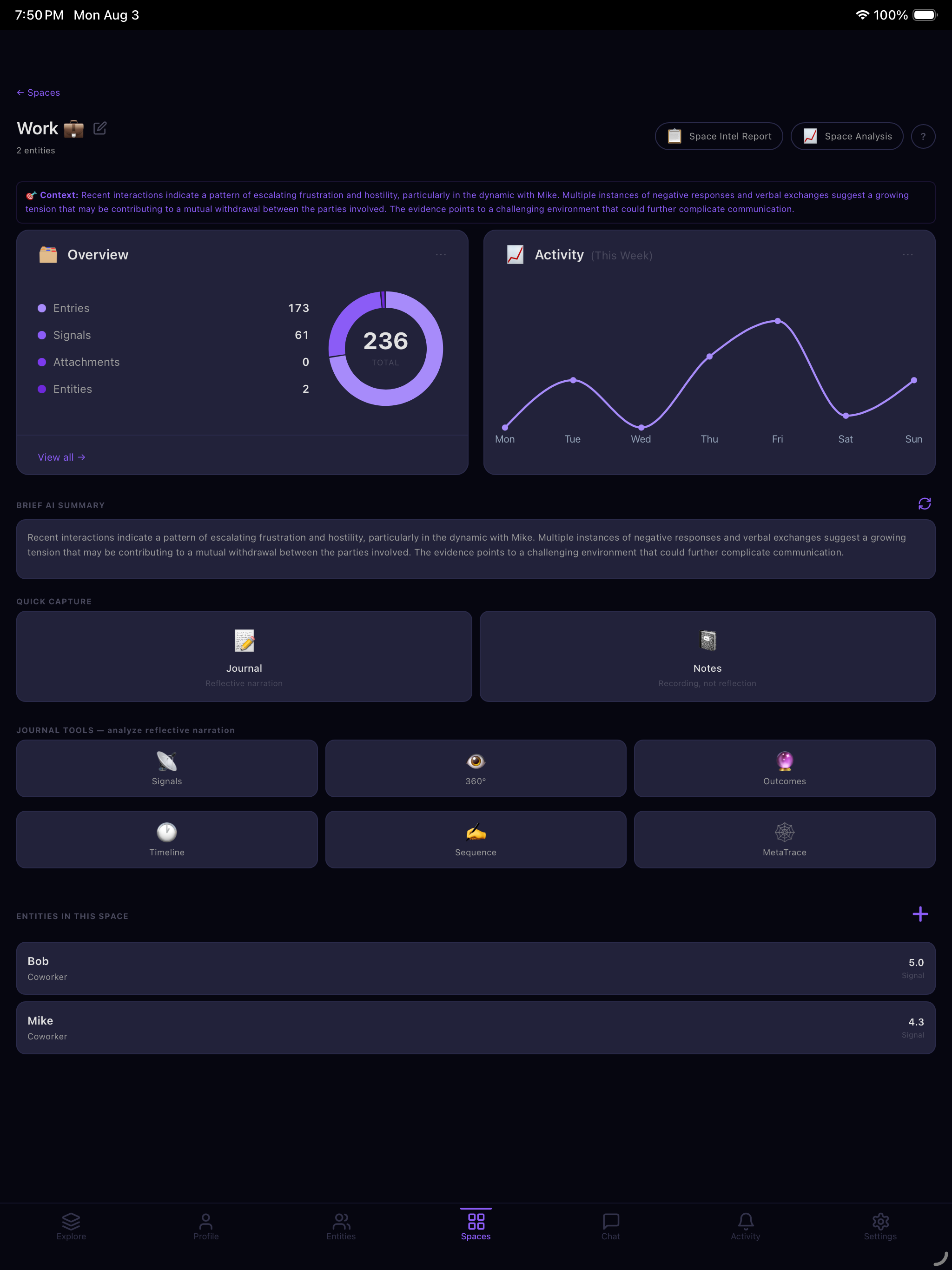
Family. Work. Friends. School. Romantic. Different contexts have different rules — MetaopAI keeps them separate, and lets intelligence flow between them only when it matters.

  • Contextual separation — what happens in Work doesn't bleed into Family unless you want it to.
  • Cross-space correlation — when patterns repeat across spaces, the system tells you.
  • Dynamic membership — entities move between spaces as life rearranges itself.
MetaopAI Spaces — Work, Friends, Family, School
Primitive 02 · Entities

People become profiles.

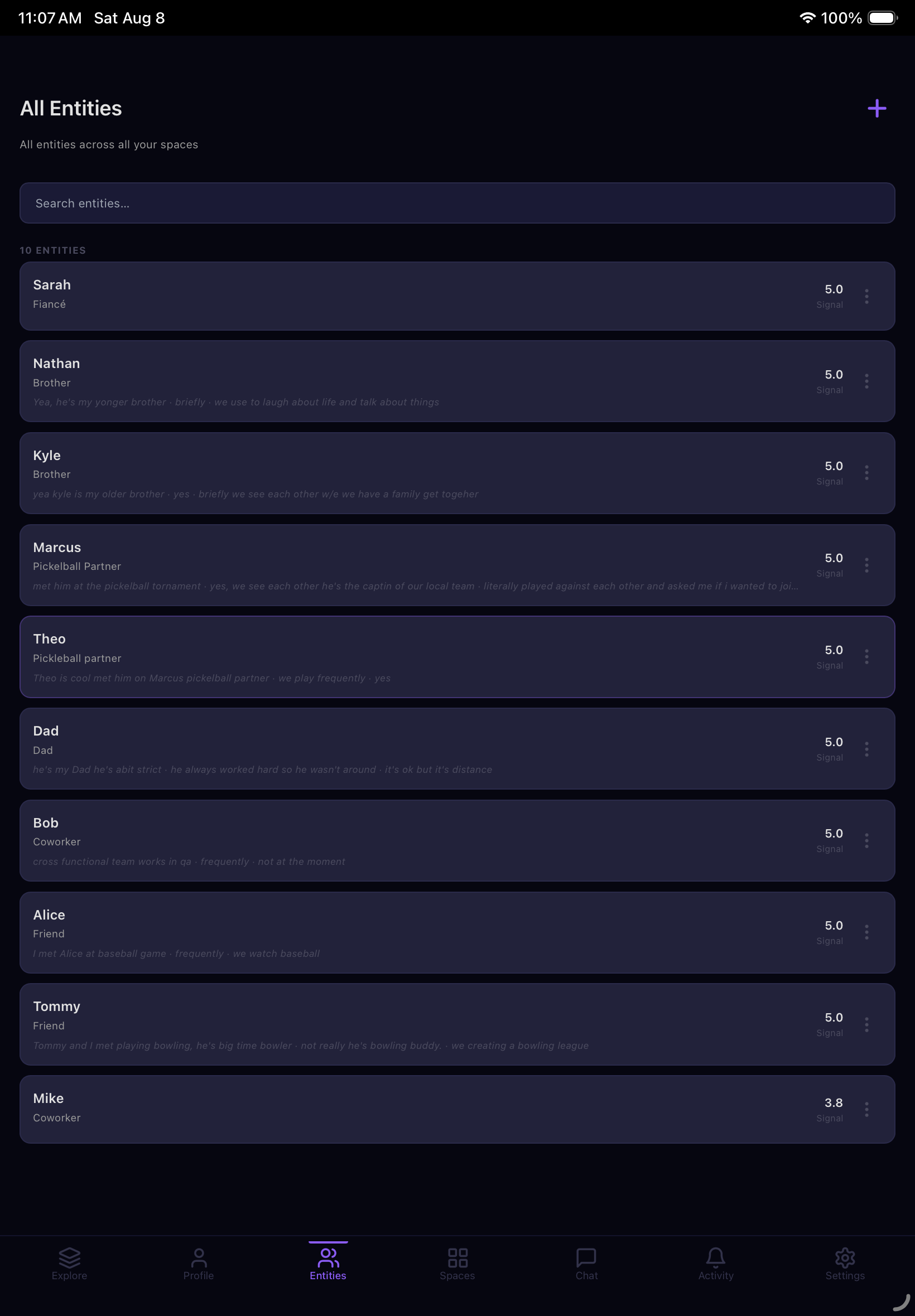
Every recurring presence in your life — partner, manager, sibling, coworker, friend — gets modeled as a living entity. Not a contact card. A signal score that evolves with every interaction you describe.

  • Signal scoring — quantified attention drawn from real interaction patterns over time.
  • Pattern detection — recurring dynamics surface automatically, with citations.
  • Append-only history — observations are never silently rewritten; contradictions surface for you to clarify.
Entity profiles in MetaopAI — Sarah, Frank, Brother, John with signal scores
Primitive 03 · You

The longitudinal portrait.

Your profile is the shape of you over time — where your attention actually goes, who holds it, how your rhythm shifts when you're under stress. Not a static bio. A living read of how you operate in the world you've built.

  • Time invested — where your attention goes, ranked across spaces and entities.
  • Rhythm fingerprint — typing tempo and pause patterns that shift when something is off.
  • Trend signals — declining, watching, trending up. Every relationship has a direction.
MetaopAI Profile — Time invested, top entities by volume, trend analysis
Output · Notifications

Signals, patterns, compounded.

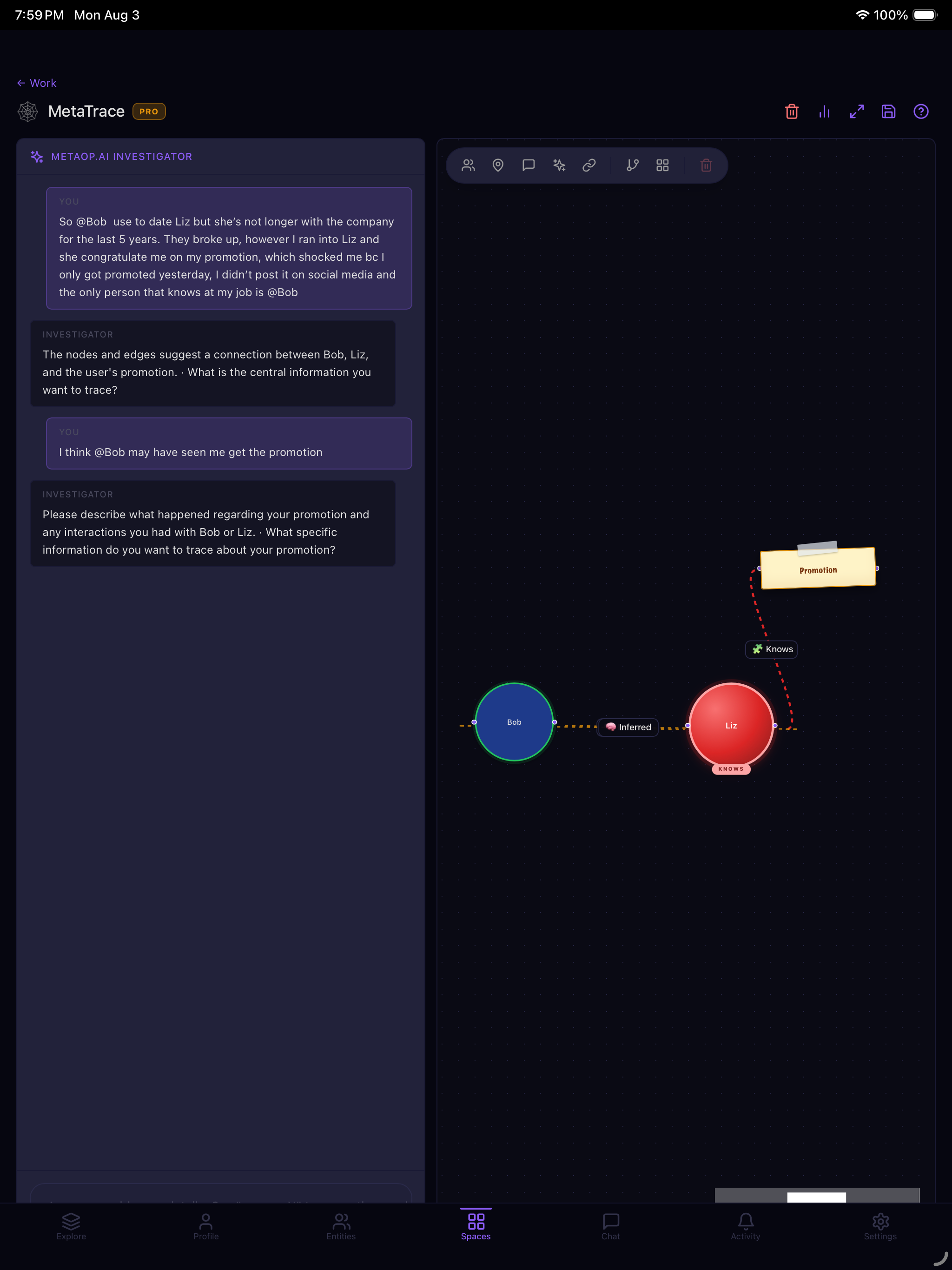
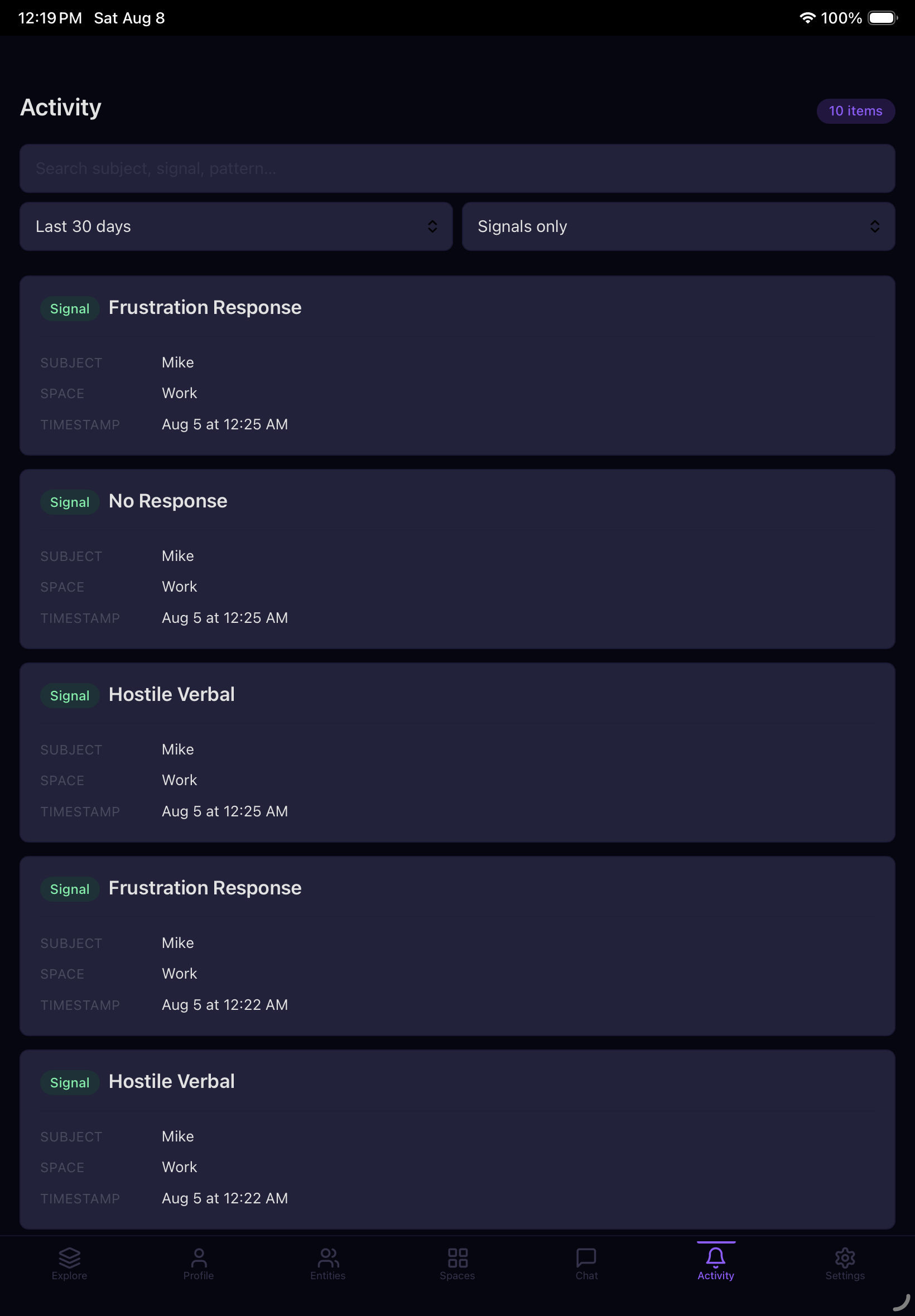
Every observation the system makes is auditable. Type, subject, space, timestamp, strength. You can trace any insight back to the journal entries that produced it. Nothing happens behind a curtain.

  • Signal — a single thing the AI noticed.
  • Pattern — three or more similar signals within fourteen days.
  • Combined pattern — multiple patterns fused together with strength scoring.
MetaopAI Notifications — combined patterns, signals, and strength scoring
07 — Principles
Principles

Built on trust,
not on certainty.

These are not features. They're commitments — the lines that don't move regardless of what's convenient to ship.

01

Patterns, not verdicts.

The system surfaces what it observes and shows its work. It does not diagnose people, predict motives, or render judgment on anyone in your life. You stay in the chair.

02

Probabilistic, not absolute.

Every interpretation carries a confidence score. Recent observations weigh more than year-old ones. Patterns that go dormant decay; patterns that reactivate are surfaced with appropriate framing.

03

Transparent, not authoritarian.

Every surfaced pattern cites its source signals. You can audit the trail. You can dismiss a pattern. The AI never insists — it offers, and the offering can always be questioned.

04

Crisis-aware by design.

A shared safety module fires before any other reasoning across every chat surface. When the conversation moves into high-stakes territory, the AI bridges you to a human resource — it does not try to be the resource.

05

Persistent, not addictive.

The goal is clarity outside the system — better-handled conversations in your actual life. Not engagement inside an app. We measure success by how capable you feel out there, not by how often you come back.

06

Encrypted in transit and at rest.

Every narration, every signal, every pattern is encrypted. We hold the data you generate to the same standard you hold your private thoughts.

08 — Behind MetaopAI
// founder Tony // based New York // status Pre-launch, in public
Behind MetaopAI

I'm Tony.
By day, I secure AI.

For over a decade, I've worked in security and cloud infrastructure across global financial institutions, helping design and secure systems that support critical platforms and emerging technologies. Over the last several years, that work increasingly shifted toward AI — evaluating enterprise tools, securing deployments, and understanding how context, orchestration, and human behavior shape AI systems in practice.

MetaOpAI emerged from a simple observation: most AI systems treat interactions as isolated moments. People don't operate that way. Relationships, decisions, patterns, and behavior are built over time through accumulated context. MetaOpAI is an exploration of what happens when AI is designed to retain signal across those moments rather than continuously resetting the conversation.

This project remains intentionally small and hands-on. The architecture, safety systems, infrastructure, and underlying design are built with the same principles used in security engineering: deliberate decisions, observable systems, and a bias toward long-term reliability over short-term complexity.

The belief behind MetaOpAI is straightforward: context compounds. Small signals become patterns, patterns become understanding, and understanding creates clarity.

Credentials & background
M.S. Cybersecurity CISSP CompTIA Security+ · CySA+ · PenTest+ · CNSP Microsoft Azure Security Engineer · AZ-500 Azure Administrator · AZ-104 CCNA · Cyber Ops & Routing/Switching AI security & context engineering practitioner A decade-plus in enterprise security engineering Financial-services & capital-markets infrastructure
09 — Begin
An open experiment

Be understood.

MetaopAI is a probabilistic interpersonal cognition system. It extracts signals, events, and emotional atmosphere from what you write, structures them in a typed Knowledge Representation Layer, models the relationships and spaces in your life as evolving state, and compounds recurring observations into longitudinal patterns — with confidence scoring, contradiction handling, and temporal decay built in.

Not an oracle that claims to know the truth. A contextual interpretation engine that gets sharper the longer you write.

Confidence over certainty.
Interpretation over diagnosis.
Patterns, not verdicts.